
LG U+ files administrative lawsuit over recognition of employer status for subcontracted workers… Six rounds of prime contractor negotiations also collapse
English translation of the original Korean report. Images and source documents may contain Korean text.
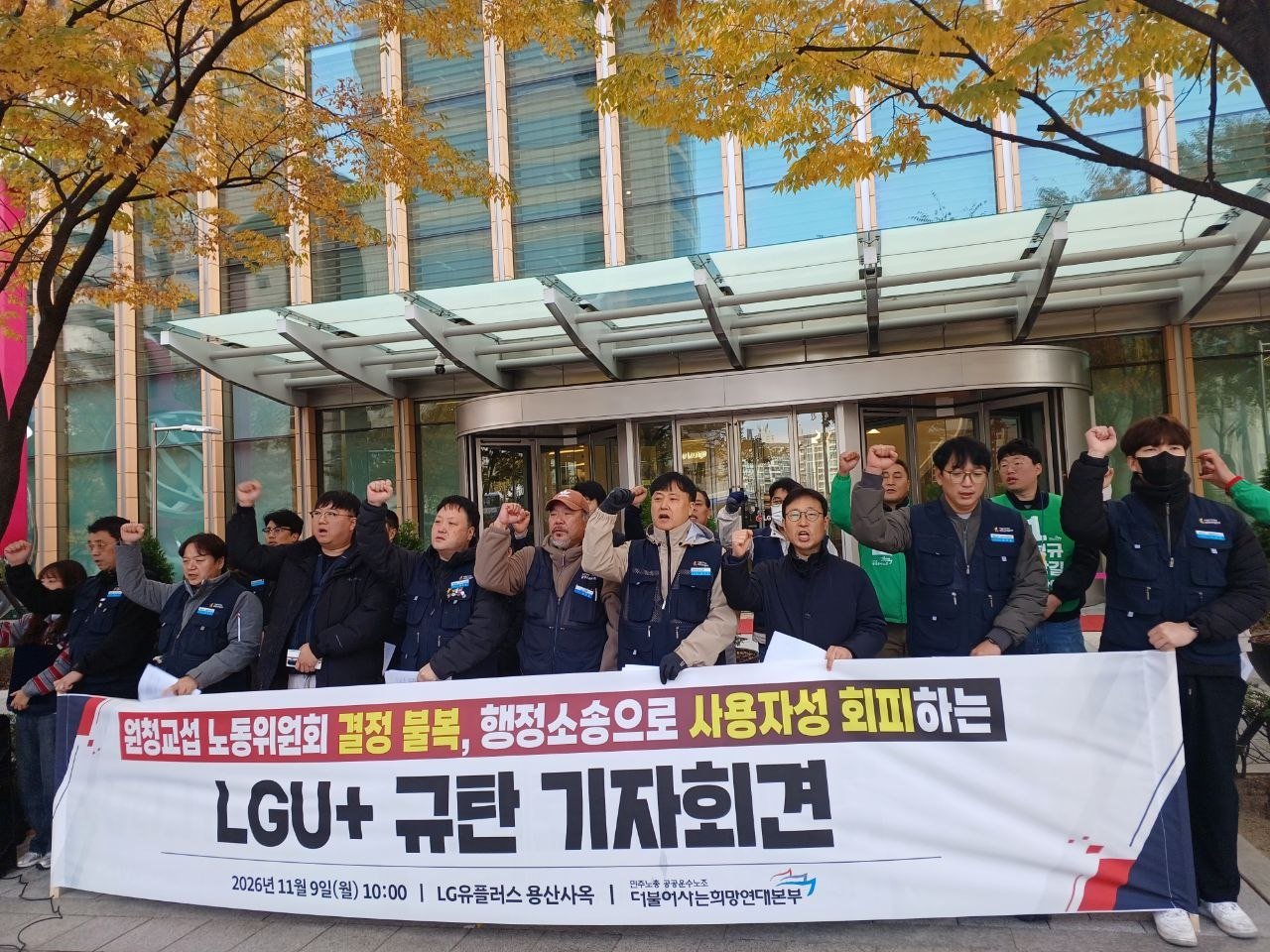
Hope Solidarity Headquarters protests Central Labor Relations Commission’s decision… “Recruiting strike replacement workers and limiting negotiation agenda”
LG U+ filed an administrative lawsuit challenging the Central Labor Relations Commission’s decision that recognized the prime contractor’s employer status for subcontracted workers. As six rounds of prime contractor negotiations held after the Labor Relations Commission’s decision also collapsed, the labor union criticized the company for evading its responsibility for negotiations.
According to the Korean Public Service and Transport Workers’ Union on the 10th, the Hope Solidarity Headquarters for Living Together held a press conference in front of the LG U+ office building in Yongsan-gu, Seoul the previous day, demanding the withdrawal of the administrative lawsuit and substantive prime contractor negotiations.
This conflict began on April 9 when the LG U+ Non-regular Workers’ Branch requested prime contractor negotiations. The Seoul Regional Labor Relations Commission recognized LG U+’s employer status as a prime contractor on June 1, and the Central Labor Relations Commission reached the same conclusion in a retrial on July 28.
Accordingly, LG U+ and the Non-regular Workers’ Branch began negotiations on August 24, but failed to reach an agreement in six rounds of negotiations through October 28. The union proposed the working environment, work methods, wages and benefits, and the guarantee of labor union activities as negotiation agendas.
■ From limiting the negotiation agenda to allegations of recruiting replacement workers
The Hope Solidarity Headquarters claimed that LG U+ limited the labor safety agenda to ‘safety construction’ and refused to discuss other demands. They explained that although the Central Labor Relations Commission ruled that the working environment and work methods could also be considered negotiation agendas, the company maintained its existing position.
Allegations of recruiting strike replacement workers were also raised. The headquarters claimed that on September 28, LG U+ recruited replacement workers from the NW Infrastructure Group’s operations team by offering fuel cost support, evaluations, and incentives. The union views this as a measure to weaken the effectiveness of industrial action.
Workers belonging to the Non-regular Workers’ Branch held on-site strikes on September 29 and 30, and following a general strike resolution rally on October 23, they went on strike again from October 26 to 30. The headquarters stated that the branch has a total of 1,257 members, including 865 from U+ Home Service, a subsidiary of LG U+, and 392 from 34 partner companies.
LG U+ participated in the 5th round of negotiations on October 14, the day it was served with the Central Labor Relations Commission’s retrial decision, and also held the 6th round of negotiations on the 28th of the same month. However, it filed an administrative lawsuit challenging the decision recognizing the prime contractor’s employer status. While administrative litigation is a legal procedure to appeal a Labor Relations Commission decision, the union is taking issue with the company’s response of disputing its employer status while still participating in negotiations.
Je Yu-gon, head of the LG U+ Non-regular Workers’ Branch, criticized the company’s recruitment of replacement workers and its pursuit of an administrative lawsuit as acts of evading responsibility as a prime contractor employer. However, no separate position from the company regarding the reasons for the lawsuit or the circumstances of the replacement worker recruitment has been confirmed.
In future litigation, the dispute is expected to continue over the validity of the recognition of the prime contractor’s employer status, while in labor-management negotiations, the dispute will likely center on specific negotiation agendas and the scope of responsibility.