
KB Financial Chairman Jae Keun Lee Pledged to ‘Listen to Shareholders’… One Week Into His Term, Allegations of Minority Shareholders Being Denied Entry
English translation of the original Korean report. Images and source documents may contain Korean text.
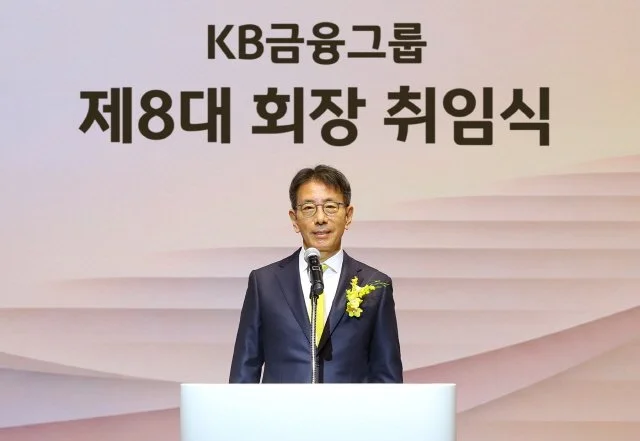
Lee emphasizes direct engagement in his first public engagement outside the company; received 5.221 billion won in compensation over three years as KB Kookmin Bank president amid questions over responsibility for 578.2 billion won in penalties imposed on affiliates
As Jae Keun Lee, chairman of KB Financial Group, marked one week since the start of his term on the 28th, allegations emerged that a minority shareholder was denied entry to the extraordinary general meeting of shareholders that determined his appointment as chairman.
Having emphasized direct engagement with people in his first public engagement outside the company after taking office, Lee now faces questions over how he will respond to the controversy surrounding the alleged infringement of shareholder rights during his own appointment process.
According to KB Financial Group and civic organizations on the 28th, Lee held his inauguration ceremony on the 23rd and outlined a management approach that would place customers’ interests and trust above all else in business decisions.
In a press release issued the following day, KB Financial said Lee began his first official engagement by meeting young people and small business owners in person and listening to the difficulties they faced.
Immediately after being nominated as a candidate for chairman last September, Lee said, “I will always remain humble and sincerely listen to the voices of customers, shareholders, executives and employees, and the media.”
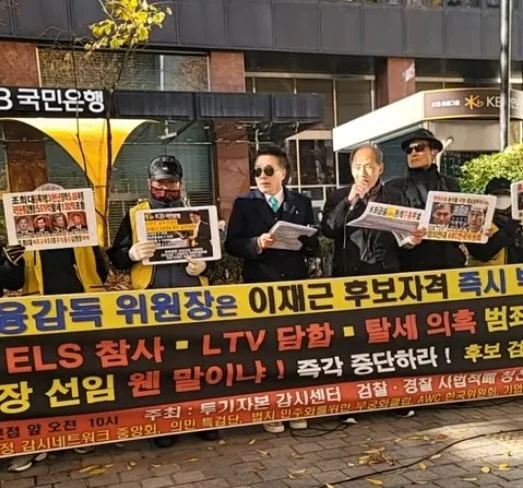
However, controversy over restrictions on minority shareholder access erupted at the extraordinary general meeting held at the headquarters of KB Kookmin Bank in Yeouido, Seoul, on the 20th, as nine civic organizations, including Speculative Capital Watch Korea, demanded that Lee’s appointment be deferred and the grounds for his vetting as a candidate be disclosed.
At a press conference outside the headquarters that day, the organizations called on Financial Supervisory Service Governor Lee Chan-jin to halt the chairman appointment process, on KB Financial’s board of directors to defer the resolution appointing Lee as an inside director, and on KB Kookmin Bank to disclose the status of compensation for losses related to Hong Kong equity-linked securities (ELS).
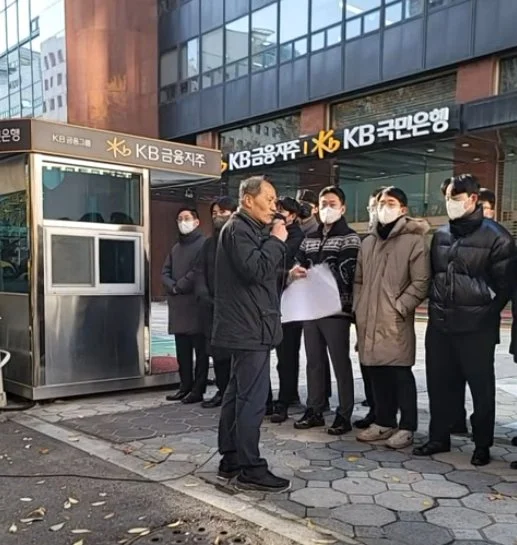
According to the organizations, Yoon Young-dae, co-representative of Speculative Capital Watch Korea, who worked at KB Kookmin Bank for 30 years and owns 27 common shares of KB Financial, requested entry to the shareholders’ meeting venue, but some 20 employees formed a line with their arms interlocked and blocked his access.
The organizations alleged that Yoon asked about the legal grounds for restricting his access and who had issued the instructions, but received no answer. The record date for exercising voting rights at the shareholders’ meeting was October 19.
The resolution appointing Lee as an inside director was approved with votes in favor representing 97.69% of the shares represented at the meeting and 76.14% of the total issued shares.
Lee’s three-year term runs from the 21st through November 20, 2029. KB Financial is a financial holding company without an individual controlling owner. As of the end of September, its largest shareholder was the National Pension Service, with a 9.18% stake.
■ Affiliates face 578.2 billion won in penalties… Questions over responsibility for collusion during Lee’s tenure as bank president
The civic organizations’ opposition to Lee’s appointment stems from a series of regulatory sanctions imposed on KB Financial affiliates.
On the 4th, the Financial Services Commission imposed a financial penalty of 172.334 billion won and an administrative fine of 1.3 billion won on KB Kookmin Bank for the mis-selling of equity-linked securities (ELS) tied to Hong Kong’s Hang Seng China Enterprises Index (H-share index).
In February, the Korea Fair Trade Commission imposed a penalty of 69.747 billion won on KB Kookmin Bank for collusion involving the exchange of information on real estate loan-to-value (LTV) ratios. On the 11th, it also decided to impose penalties of 332.178 billion won on KB Securities and approximately 3.9 billion won on KB Kookmin Bank for collusion in government bond auctions.
In the government bond collusion case, the Korea Fair Trade Commission determined that 15 government bond primary dealers had coordinated bidding interest rates between January 2020 and June 2023 and imposed penalties totaling 1.6266 trillion won. KB Securities received the largest penalty among the 15 firms and was also among the seven firms the commission decided to refer for criminal prosecution. KB Securities explained that the conduct had occurred in the course of fulfilling its government bond market-making obligations.
The organizations also raised concerns about the scale of ELS-related losses. According to figures presented by the organizations, the banking sector’s affected investments involved approximately 170,000 accounts, with an investment principal of 10.4 trillion won and losses of 4.6 trillion won. By the end of June last year, five banks, namely KB Kookmin Bank, Shinhan Bank, Hana Bank, NH NongHyup Bank and Standard Chartered Bank Korea, had paid customers a combined 1.3437 trillion won in compensation.
The organizations estimated losses incurred by KB Kookmin Bank customers at 2.2 trillion won and compensation at 639.8 billion won, alleging that the bank had not disclosed the exact amounts of losses and compensation.
Lee served as president of KB Kookmin Bank from January 2022 through the end of 2024. The period during which the Korea Fair Trade Commission determined that LTV collusion had occurred, from March 2022 to March 2024, falls within Lee’s tenure as bank president.
The organizations alleged that Lee had used key performance indicators (KPIs) to encourage bank branches to sell ELS products while serving as head of the Sales Group at KB Kookmin Bank.
National Solidarity raised the issue of management accountability, citing a Supreme Court precedent under which executives may be held legally liable if they cause damage to a company by neglecting to establish internal control systems or fulfill their oversight duties, even if they did not directly order unlawful conduct.
Justice Solidarity also claimed that a criminal complaint related to Hong Kong ELS had been received by the Serious Crime Investigation Agency on the 16th and subsequently transferred to Seoul Yeongdeungpo Police Station on the 18th, arguing that the investigation results and a review by financial authorities should precede the appointment.
KB Kookmin Bank challenged the penalty imposed for LTV collusion by filing a lawsuit with the Seoul High Court in March seeking to overturn the administrative decision. Regarding the government bond auction collusion case, KB Securities also stated, “We plan to thoroughly review the Korea Fair Trade Commission’s written decision and take follow-up measures.”
On the 11th, KB Financial issued a corrective disclosure reflecting the relevant regulatory sanctions, reducing its consolidated net profit attributable to controlling shareholders for the third quarter of this year by 148.6 billion won from the previously announced figure.