
“Why Are Updates So Slow?” Hyundai’s Pleos Draws Complaints Over Instrument Cluster Recognition Errors and Apps
English translation of the original Korean report. Images and source documents may contain Korean text.
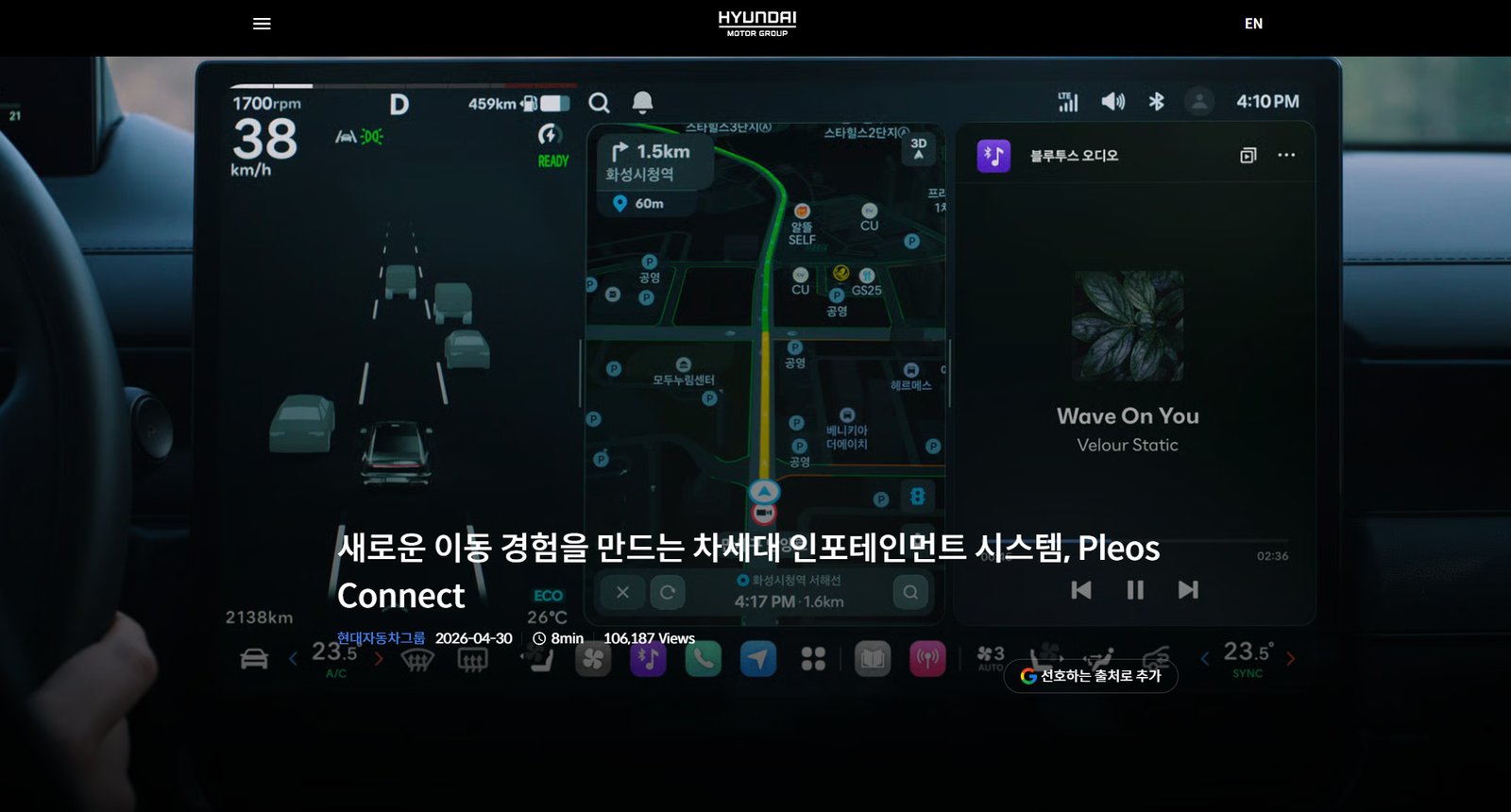
A user of Hyundai Motor Group’s next-generation in-vehicle software, Pleos Connect, posted on an online community for employees, pointing to errors in the instrument cluster’s display of roads, pedestrians and vehicles, as well as slow software updates.
According to the automotive channel of Blind, an anonymous online community for employees, on the 28th, the author published a post titled “Why Are Pleos Updates So Slow?” The author wrote, “Hyundai’s Pleos instrument cluster has a recognition failure rate of over 90% for roads, pedestrians and vehicles.” The 90% failure rate is a figure provided by the author.
The instrument cluster is the driving information display located on the dashboard in front of the driver. Claiming that surrounding pedestrians, vehicles and roads were not displayed properly, the author described the issue: “People suddenly start moonwalking, and cars suddenly appear and disappear…” The author said roads also appeared and disappeared.
The author particularly questioned the quality of the instrument cluster and challenged the decision to incorporate it into vehicles in its current state. The instrument cluster displays information for drivers, including speed, driving status, surrounding vehicles and pedestrians.
The author also complained about inconveniences with the Melon music app, saying individual songs could not be deleted, requiring the entire playlist to be changed instead.
The author also drew comparisons with Chinese companies, writing, “Even Xiaomi and BYD aren’t this bad,” and adding, “I think even university students could make something better than this if they were asked to develop it as a research project.”
Pleos Connect is a next-generation infotainment (information and entertainment) system unveiled by Hyundai Motor Group last April. It allows users to download and use apps much like on a smartphone. Starting with the new Grandeur, the system has been incorporated into the All-New Avante and Tucson. Hyundai Motor Group announced a target of equipping approximately 20 million vehicles worldwide with the system by 2030.
On the 30th of last month, Hyundai Motor Company announced that it would gradually roll out over-the-air (OTA) software updates to customers of the New Grandeur. The updates add a door-lock button and a gear-shift window to the instrument cluster and enhance the capabilities of its voice AI assistant, Gleo AI.
■ “The Result of Pouring in 2 Trillion Won?” 42dot Posts 27.7 Billion Won in Revenue and 363.9 Billion Won in Net Loss
At the end of the post, the author asked, “Is this the result of pouring in 2 trillion won?” According to the Financial Supervisory Service’s electronic disclosure system, DART, Hyundai Motor Company and Kia have invested or committed to investing a combined 2.0177 trillion won in 42dot, an affiliate that supplies Pleos software. The total comprises 1.2205 trillion won from Hyundai Motor Company and 797.2 billion won from Kia, including 475.3 billion won in capital increases through new share issuance decided last month.
42dot recorded consolidated revenue of 27.7 billion won last year but posted an operating loss of 349.8 billion won and a net loss of 363.9 billion won. Its net loss more than doubled from 175.4 billion won the previous year, while its accumulated deficit rose from 559 billion won to 922.9 billion won within a year.
As of the end of last year, Hyundai Motor Company held a 57.70% stake in 42dot, while Kia held 38.47%. Its CEO is President Minwoo Park, who previously worked at NVIDIA and Tesla and concurrently serves as Head of the Advanced Vehicle Platform (AVP) Division at Hyundai Motor Company and Kia. Hyundai Motor Company described 42dot as a company that “provides software for Hyundai Motor Group’s software-defined vehicles (SDVs).”
Meanwhile, Hyundai Motor Company’s largest shareholder was Hyundai Mobis, which held a 22.50% stake as of the end of September. Hyundai Motor Group Executive Chair Euisun Chung serves as a Representative Director of Hyundai Motor Company and directly holds a 2.75% stake, with the combined stake including related parties amounting to 30.86%.