
Kolon TissueGene faces 138.5 billion won CB time bomb, more than twice its cash holdings, with December trial results as the potential trigger
English translation of the original Korean report. Images and source documents may contain Korean text.
Stock plunge following clinical trial failure generates 73.2 billion won in accounting profit, while 358.1 billion won in development costs remains unimpaired
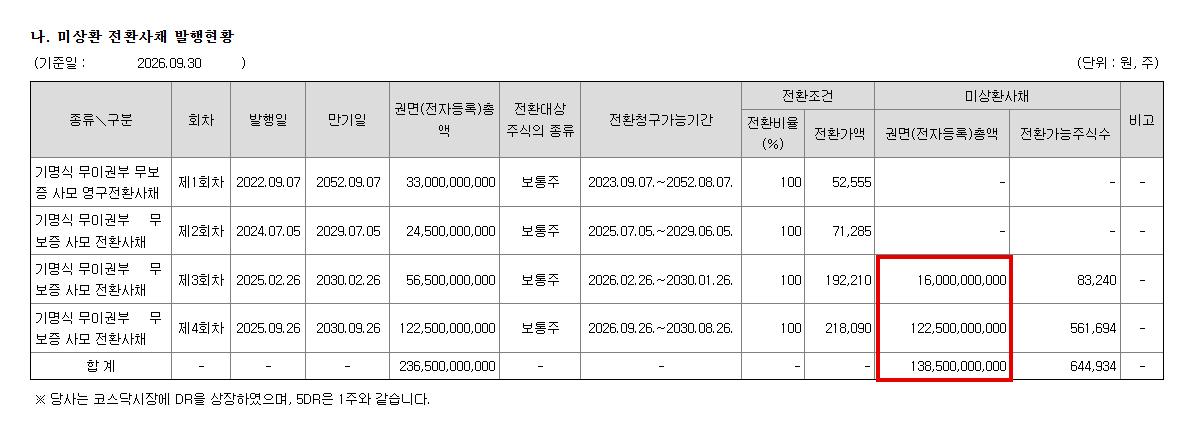
Kolon TissueGene has 138.5 billion won in outstanding convertible bonds for which investors can demand principal repayment starting next year. The company’s cash holdings stood at approximately 60 billion won at the end of September, less than half that amount.
With the share price having fallen to around one-third of the conversion price, bond investors would be better off getting their money back than converting their bonds into shares.
The results of the second U.S. Phase 3 clinical trial of TG-C, an osteoarthritis treatment formerly known as Invossa, due next month, have become a key variable in determining the company’s financial position.
According to the Financial Supervisory Service’s electronic disclosure system (DART) on the 27th, Kolon TissueGene’s outstanding convertible bonds as of the end of September comprised 16 billion won in its third issuance and 122.5 billion won in its fourth issuance. Both issues carry a zero percent interest rate, and investors can demand principal repayment every three months beginning two years after issuance. The redemption rights become exercisable on February 26 next year for the third issuance and September 27 next year for the fourth issuance.
The conversion prices are 38,442 won for the third issuance and 43,618 won for the fourth issuance, based on Korean Depositary Receipts (KDRs) listed in South Korea, with five KDRs representing one underlying share. Kolon TissueGene’s KDRs traded in the 15,000-won range this week. For the third issuance, the conversion price cannot be lowered below 90% of its original level at issuance, even if the share price falls.
The share price collapsed on July 20. The company announced that, in its first U.S. Phase 3 clinical trial, TG-C had failed to demonstrate statistically significant effects compared with a placebo, or dummy treatment, on either the pain score (VAS) or the joint function score (WOMAC) at 12 months. The reduction in pain scores was actually greater in the placebo group, at 39.2, than in the TG-C group, at 38.7.
■ Stock price collapse generates 73.2 billion won in profit, while 358.1 billion won in development costs remains on the books
Following the clinical trial failure, the company recorded a profit on its books. Kolon TissueGene posted a net profit of $50.07 million (approximately 73.2 billion won) for January through September this year, reversing a loss of $48.6 million in the same period last year.
This resulted from a decline in the value of the conversion rights attached to the convertible bonds as the share price fell, which was recognized as an accounting gain of $97.9 million from the valuation of derivatives. According to the company, its pretax loss excluding these valuation gains and losses was $32.03 million.
TG-C development costs remained recognized as assets. At the end of September, the carrying amount of development costs stood at $263.62 million (approximately 358.1 billion won), accounting for 82% of the company’s total assets. Despite the failure of the first Phase 3 trial, no impairment losses, which are expenses that reduce the carrying value of assets, were recognized through the third quarter, with the amount standing at zero won. This year alone, an additional $46.34 million was capitalized as development costs, including $6.69 million in borrowing costs.
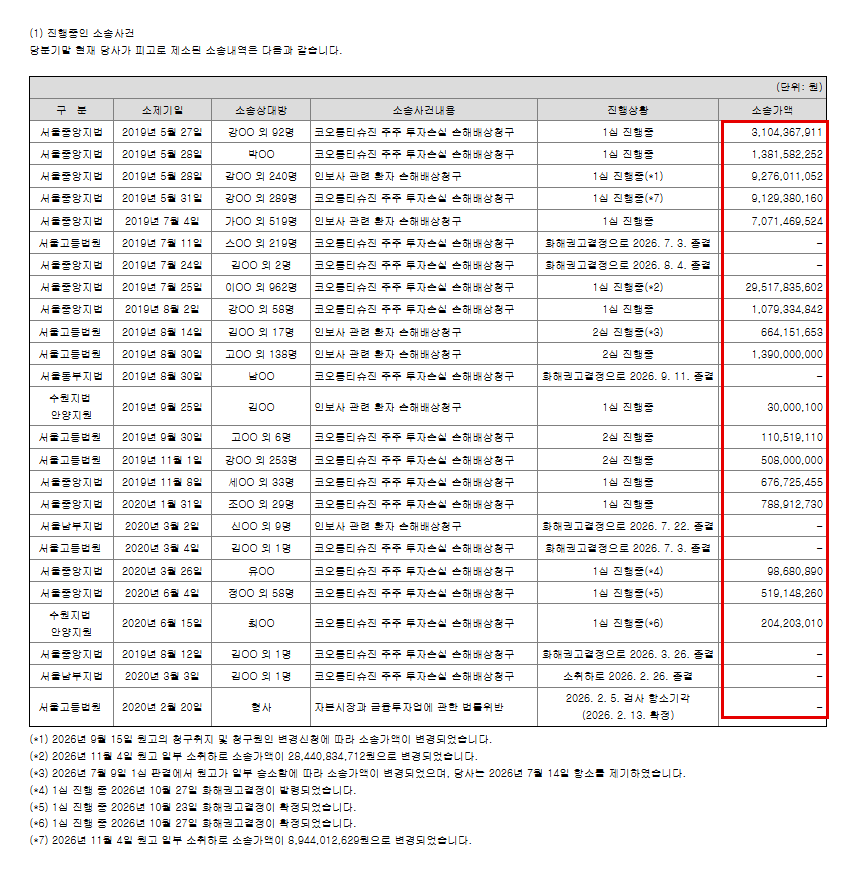
Litigation stemming from the Invossa controversy also remains unresolved. Combining the third-quarter report with the revised amounts in litigation disclosed this month, claims in unresolved cases in which the company is a defendant total approximately 63.6 billion won.
After plaintiffs partially prevailed in a first-instance ruling on July 9 in a lawsuit brought by patients who had received Invossa, the company recognized a litigation provision of $1.13 million for the first time and appealed the ruling. Several shareholder lawsuits have concluded since July through court-issued settlement recommendations.
Kolon Group Honorary Chairman Woong Yeul Lee, who was indicted in connection with the Invossa controversy, was also acquitted on appeal in February. His acquittal became final after prosecutors chose not to appeal to the Supreme Court.
The company transitioned to a sole-CEO structure under Seng Ho Jeon in September following the departure of CEO Moon Jong Noh. The announcement of the topline results of the second Phase 3 clinical trial was postponed from October to December, and the company plans to release additional analysis of the first trial alongside those results. The company intends to apply for marketing approval from the U.S. Food and Drug Administration (FDA) if statistical significance is demonstrated.
Meanwhile, Kolon TissueGene’s largest shareholder is holding company Kolon Corporation, with a 39.10% stake, while Honorary Chairman Woong Yeul Lee holds 14.02% and Kolon Life Science holds 9.03%. Honorary Chairman Lee is the largest shareholder of Kolon Corporation, with a 44.67% stake.
Kolon Corporation issued 60 billion won in exchangeable bonds in March and participated in Kolon TissueGene’s paid-in capital increase at 101,665 won per KDR. The current share price is 85% below that level.
Kyu Ho Lee, Vice Chairman of Kolon Corporation and the eldest son of Honorary Chairman Lee, became an inside director of Kolon TissueGene in March. On July 27, one week after the announcement of the first clinical trial results, he purchased 13,158 KDRs worth approximately 200 million won at an average price of 15,200 won each.