
Hanwha Group Chairman Kim Seung-youn Receives 24.841 Billion Won From Five Affiliates; High Compensation for Controlling Shareholders Holding Multiple Positions Under Scrutiny
English translation of the original Korean report. Images and source documents may contain Korean text.
5 Billion Won Each From Hanwha Corporation, Hanwha Solutions, Hanwha Systems and Hanwha Aerospace; 4.68 Billion Won From Hanwha Vision
Number of Controlling Shareholders Receiving at Least 5 Billion Won Rises From 26 to 39 When Compensation From Multiple Positions Is Combined
Hanwha Group Chairman Kim Seung-youn received 24.841 billion won in compensation from five affiliates last year, up 77.68% from the previous year, prompting concerns that the lack of detailed disclosures about controlling shareholders’ roles and contributions at individual affiliates makes it difficult to assess the appropriateness of high compensation received through multiple positions.
According to a report titled ‘Analysis of Executive Compensation in 2025 and Compensation-Related Shareholder Meeting Agenda Items in 2026,’ released by the Economic Reform Research Institute on the 24th, Kim received 5.041 billion won from Hanwha Solutions, 5.04 billion won each from Hanwha Corporation, Hanwha Systems and Hanwha Aerospace, and 4.68 billion won from Hanwha Vision.
According to last year’s annual reports posted on the Financial Supervisory Service’s electronic disclosure system, Hanwha Solutions paid Kim a monthly salary of 420 million won, while Hanwha Vision paid him 390 million won per month. Neither company paid him a bonus.
Of the 10.86 billion won increase, 4.68 billion won represented compensation Kim received from Hanwha Vision for the first time. Hanwha Vision was established in September 2024 through a spin-off from Hanwha Aerospace, in which shares in the newly established company were distributed to existing shareholders.
His compensation from Hanwha Aerospace also rose by 3.78 billion won, from 1.26 billion won to 5.04 billion won. The institute explained that Kim was appointed chairman of the company in November 2024 without joining its board of directors, received only three months’ salary that year, and that his monthly salary remained unchanged.
Kim had been receiving compensation from four existing affiliates as chairman without serving on their boards of directors. According to the institute, Hanwha Vision cited the identification of new growth drivers at the group level, advisory services on mergers and acquisitions, and business support through overseas networks as grounds for his compensation. The other four companies used nearly identical wording, stating that they had comprehensively considered his duties, position, leadership, expertise and contributions to the company.
The institute pointed out that when one individual receives separate compensation from multiple affiliates for similar advisory and support roles, assessing the appropriateness of such compensation requires disclosure of the individual’s roles and contributions at each company and whether overlapping compensation has been adjusted.
Compared with average employee compensation at the five companies, Kim’s compensation was 57.2 times higher at Hanwha Solutions, 54.2 times at Hanwha Corporation, 46.7 times at Hanwha Systems, 40.6 times at Hanwha Aerospace and 38.0 times at Hanwha Vision. The gap widens further when compensation from all five companies is combined.
■ Number of Controlling Shareholders Receiving at Least 5 Billion Won Rises From 26 to 39 When Compensation From Multiple Positions Is Combined
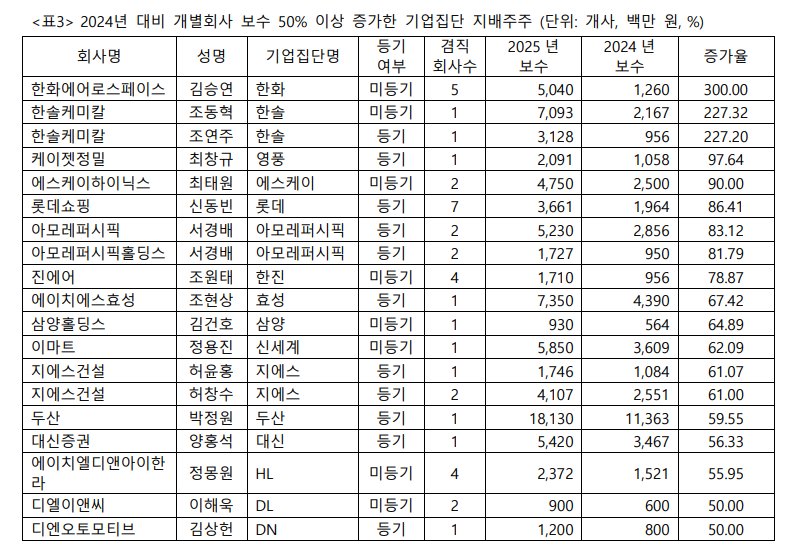
Hanwha is not the only business group to see a substantial increase in compensation through multiple positions. Hanjin Group Chairman Cho Won-tae was appointed chairman of Asiana Airlines without joining its board of directors in January last year and received 987 million won in new compensation, while his combined compensation, including payments from Hanjin KAL, Korean Air and Jin Air, increased by 42.74%, from 10.213 billion won to 14.578 billion won.
Last year, executives who received compensation from multiple affiliates included 116 controlling shareholders and six professional managers. All executives who received compensation from three or more affiliates were controlling shareholders. While 26 controlling shareholders received at least 5 billion won from an individual company, the number rose to 39 when compensation from multiple positions was combined.
Average compensation for controlling shareholders of large business groups stood at 2.782 billion won, more than double the 1.184 billion won received by professional managers. Doosan Group Chairman Park Jeong-won received 18.13 billion won from Doosan Corporation alone, equivalent to 135.3 times the company’s average employee compensation. The institute attributed the increase primarily to restricted stock units (RSUs) granted in 2022, whose value had risen to approximately 8.927 billion won due to an increase in the share price.
Fourteen individuals received retirement payments of at least 5 billion won, three of whom received more than 10 billion won. Poongsan Group Chairman Ryu Jin received 38.839 billion won in retirement-related payments from Poongsan Holdings.
The institute called for the introduction of a Say on Pay system under which shareholders would review compensation policies for chief executive officers and highly paid executives. It also recommended disclosing compensation from multiple positions, performance indicators and payment calculation formulas, the basis for calculating retirement payments and special merit payments, whether the voting rights of specially interested parties were restricted, and voting results.