
Hyundai Warns of Possible False Battery Overheating Diagnoses in U.S. IONIQ 5 Vehicles…Concerns Over Driving Performance Limitations
English translation of the original Korean report. Images and source documents may contain Korean text.
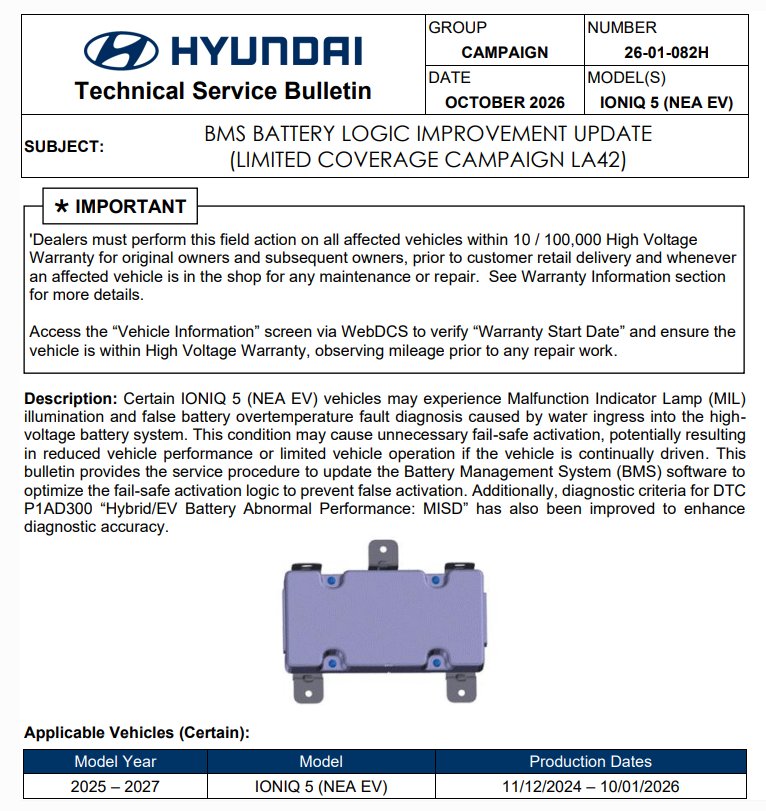
Certain 2025–2027 Models Affected…BMS Software Improvement Campaign LA42
Hyundai Motor Company has warned of the possibility that battery overheating conditions could be incorrectly diagnosed in certain IONIQ 5 vehicles sold in the United States, potentially reducing driving performance, and has established a software update procedure.
According to Hyundai Motor America’s October Technical Service Bulletin (TSB) ’26-01-082H’, publicly available through the U.S. National Highway Traffic Safety Administration (NHTSA) on the 23rd, the measure is classified as a limited coverage campaign designated ‘LA42’.
The affected vehicles are certain 2025–2027 IONIQ 5 (NEA EV) models manufactured between November 12, 2024, and October 1, 2026.
Hyundai explained that water entering the high-voltage battery system could cause a false battery overtemperature fault diagnosis and trigger the malfunction indicator lamp.
The company stated that this could unnecessarily activate the fail-safe function, potentially reducing vehicle performance or limiting vehicle operation if the vehicle continues to be driven.
■ Battery Management System Software Improvement…Applicability to South Korean Vehicles Unconfirmed
The company established a software update procedure to improve the fail-safe control logic of the Battery Management System (BMS) to prevent unnecessary activation of the protective function.
The diagnostic criteria for fault code ‘P1AD300’ were also improved to enable more accurate identification of abnormal conditions.
U.S. dealerships were instructed to perform the update on affected vehicles within the high-voltage battery warranty period of 10 years or 100,000 miles, either before delivery to customers or when the vehicles are brought in for maintenance or repairs.
The bulletin also specified that customers with active Bluelink subscriptions may be able to complete the update through an over-the-air (OTA) software update when that option becomes available.
The document is a notice concerning a limited coverage campaign rather than an announcement of an official U.S. safety recall, and it does not specify whether the measure applies to vehicles sold in South Korea or the number of actual occurrences.