
KG Eco Solution, Parent of Former SsangYong Motor, Swings to 124.9 Billion Won Q3 Loss…Potential Fines Remain Off the Books Despite Review of Alleged Collusion Involving 9.7 Trillion Won in Tenders
English translation of the original Korean report. Images and source documents may contain Korean text.
KG Mobility’s 133.2 Billion Won Net Loss Flows Through to Parent…313.1 Billion Won in Subsidiary Debt Guarantees, Early Repayment if Credit Rating Falls Two Notches
KG Eco Solution, a KG Group holding company whose subsidiaries include KG Mobility, formerly known as SsangYong Motor, and steelmaker KG Steel, swung to a third-quarter net loss of 124.9 billion won.
KG Eco Solution, which manufactures and sells bio-heavy fuel oil, is facing deliberations by the Korea Fair Trade Commission (KFTC) over allegations of bid-rigging spanning more than 11 years, but it has not reflected any expected fines in its financial statements.
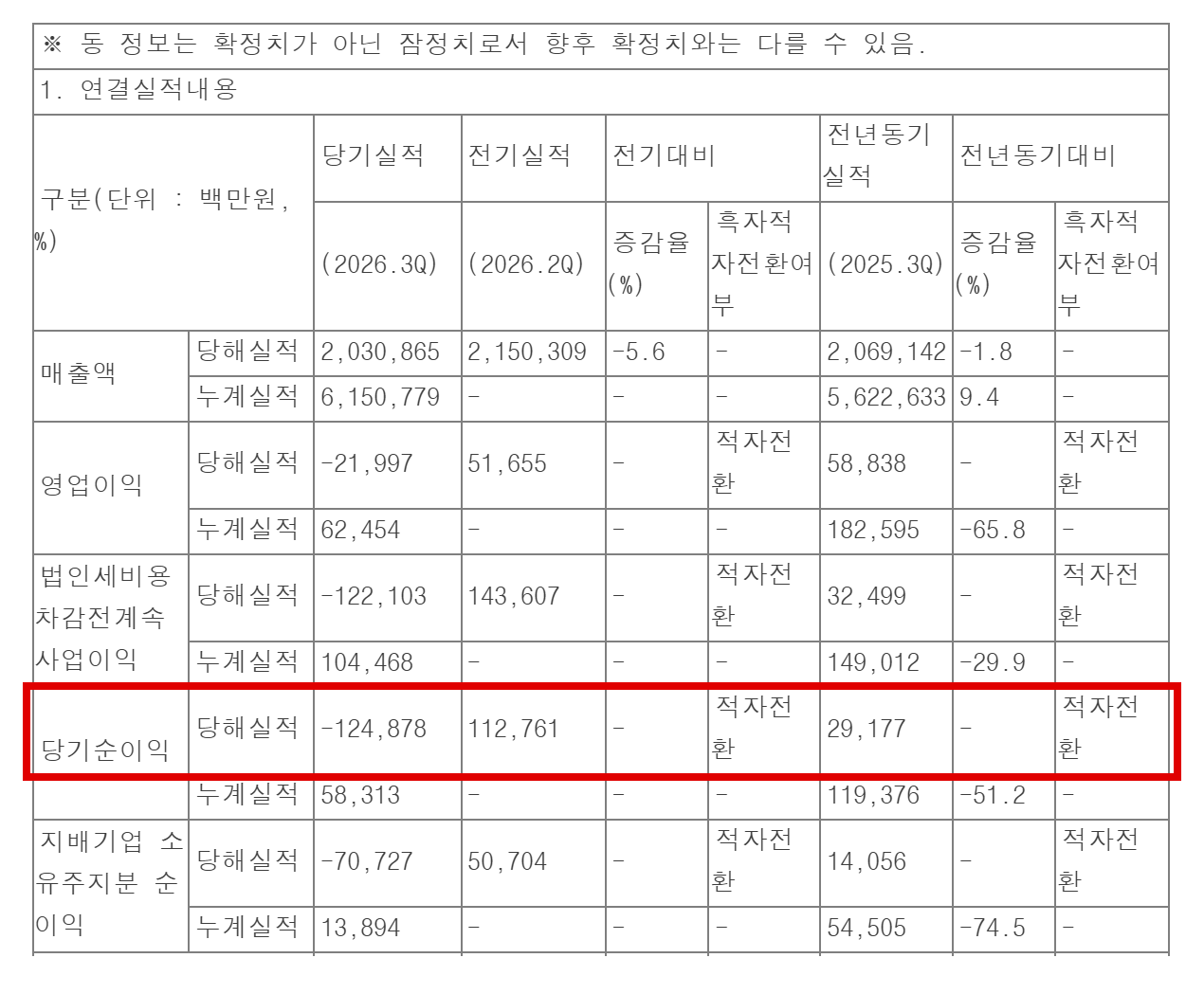
According to the Financial Supervisory Service’s electronic disclosure system on the 17th, KG Eco Solution’s consolidated revenue for the third quarter (July–September) fell 1.8% year on year to 2.0309 trillion won. Its operating result swung from a profit of 58.8 billion won to a loss of 22 billion won, while its net result shifted from a profit of 29.2 billion won to a loss of 124.9 billion won.
Most of the losses came from subsidiary KG Mobility. On a standalone basis, KG Mobility recorded an operating loss of 29.8 billion won and a net loss of 133.2 billion won in the third quarter. During the same period, KG Eco Solution’s consolidated finance costs reached 186.6 billion won, nearly seven times the 27 billion won recorded a year earlier. Of that amount, 141.6 billion won consisted of losses arising from exchange-rate fluctuations.
As a holding company, KG Eco Solution also shoulders its subsidiary’s debt burden. It provided a joint and several guarantee for 113.1 billion won in KG Mobility convertible bonds. In the third quarter, it also entered into a funding shortfall support agreement under which it would make up any shortfall in repayment funds for a 200 billion won borrowing by KG Mobility secured against future credit-card sales receivables.
The two won-denominated guarantee and support commitments total 313.1 billion won, equivalent to 56% of KG Eco Solution’s standalone equity of 556.3 billion won. A separate payment guarantee covers KG Mobility’s $18 million technology-fee obligation to China’s Chery Automobile.
The credit-card receivables-backed transaction includes a provision allowing investors to demand early repayment if KG Eco Solution’s credit rating falls by at least two notches to BB+ or below. Its current rating is BBB (stable), according to NICE Investors Service.
■ ‘Investigation Ongoing’ Even After Receiving Examiner’s Report
Bio-heavy fuel oil is the only business that the holding company, KG Eco Solution, operates directly. On a standalone basis, the company recorded revenue of 92.5 billion won and operating profit of 12.9 billion won from January through September this year.
On July 30, the KFTC Secretariat sent an examiner’s report to seven companies, including KG Eco Solution. The companies are alleged to have predetermined winning bidders, arranged for other participants to submit bids merely as cover, and allocated supply volumes among themselves in biodiesel and bio-heavy fuel oil tenders from December 2013 to February 2025. The affected tenders were worth 9.7 trillion won, including 1.95 trillion won in bio-heavy fuel oil tenders issued by Korea Southern Power, Korea Midland Power and other power companies.
The examiner recommended imposing fines and referring the companies and their current and former executives and employees for prosecution. The maximum fine is 20% of the relevant sales.
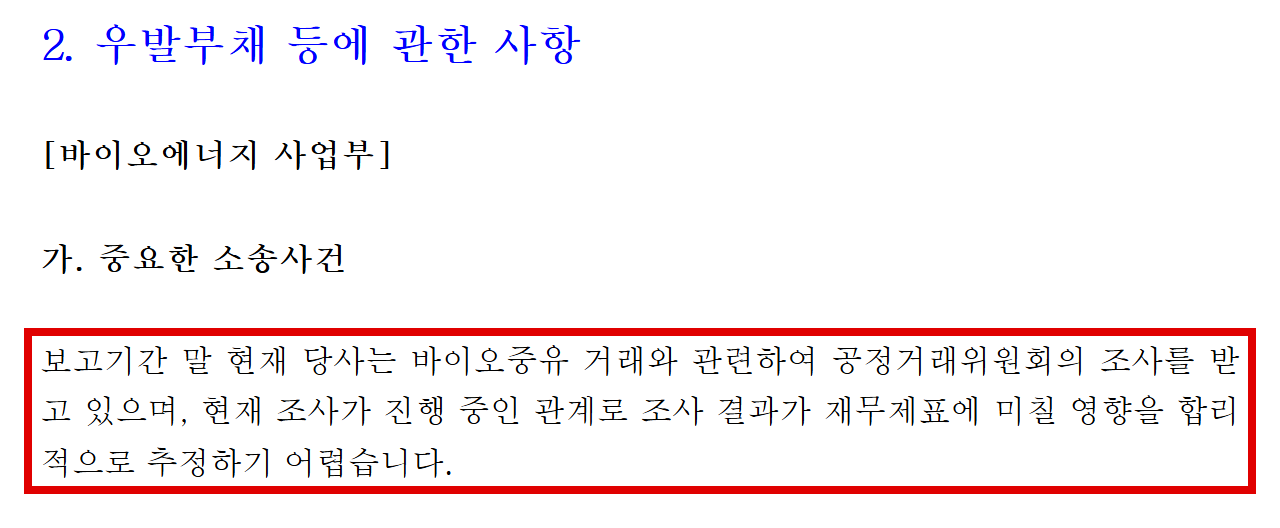
In the report, KG Eco Solution stated, “The company is under investigation by the Korea Fair Trade Commission, and because the investigation is ongoing, it is difficult to reasonably estimate the impact that the investigation’s outcome may have on the financial statements.” Even after the case had moved to the commission’s deliberation stage, the company retained language describing it as still under investigation and did not recognize the expected fines as a loss.
KG Eco Solution’s largest shareholder is KG Chemical, which holds a 42.64% stake. KG Chemical’s largest shareholder is KG Zeroin (22.54%), while KG Zeroin’s largest shareholder is Kwak Jeong-hyun (34.84%), the eldest son of KG Group Chairman Kwak Jae-sun and CEO of KG Chemical.
Chairman Kwak has served as an inside director of KG Eco Solution since 2012, while CEO Kwak serves as an unregistered chief strategy officer (CSO). The company’s board has only one independent director, Suh Dong-jin, who is also a vice chairman of the Korea Biofuels Forum.
Ownership at the top of the group is increasingly concentrated around CEO Kwak. Since August 2024, he has purchased 1.31 million KG Chemical shares on the open market, raising his stake to 5.38%, while KG Zeroin bought an additional 650,000 shares in July and August this year. In January this year, four children from the controlling family, born between 2020 and 2024, purchased 154,000 KG Chemical shares worth approximately 765 million won using funds obtained through ‘gifts and other means.’
When it sent the examiner’s report, the KFTC said it would hear the companies’ views before convening the commission to determine the level of any sanctions. According to the KFTC, the relevant sales figure is expected to be calculated at more than 9.7 trillion won.