
Taekwang ‘Backdoor Succession’ Allegations Resurface: Affiliates Lend 255.1 Billion Won to PFVs in Which Lee Ho-jin’s Children Invested 2.8 Billion Won
English translation of the original Korean report. Images and source documents may contain Korean text.
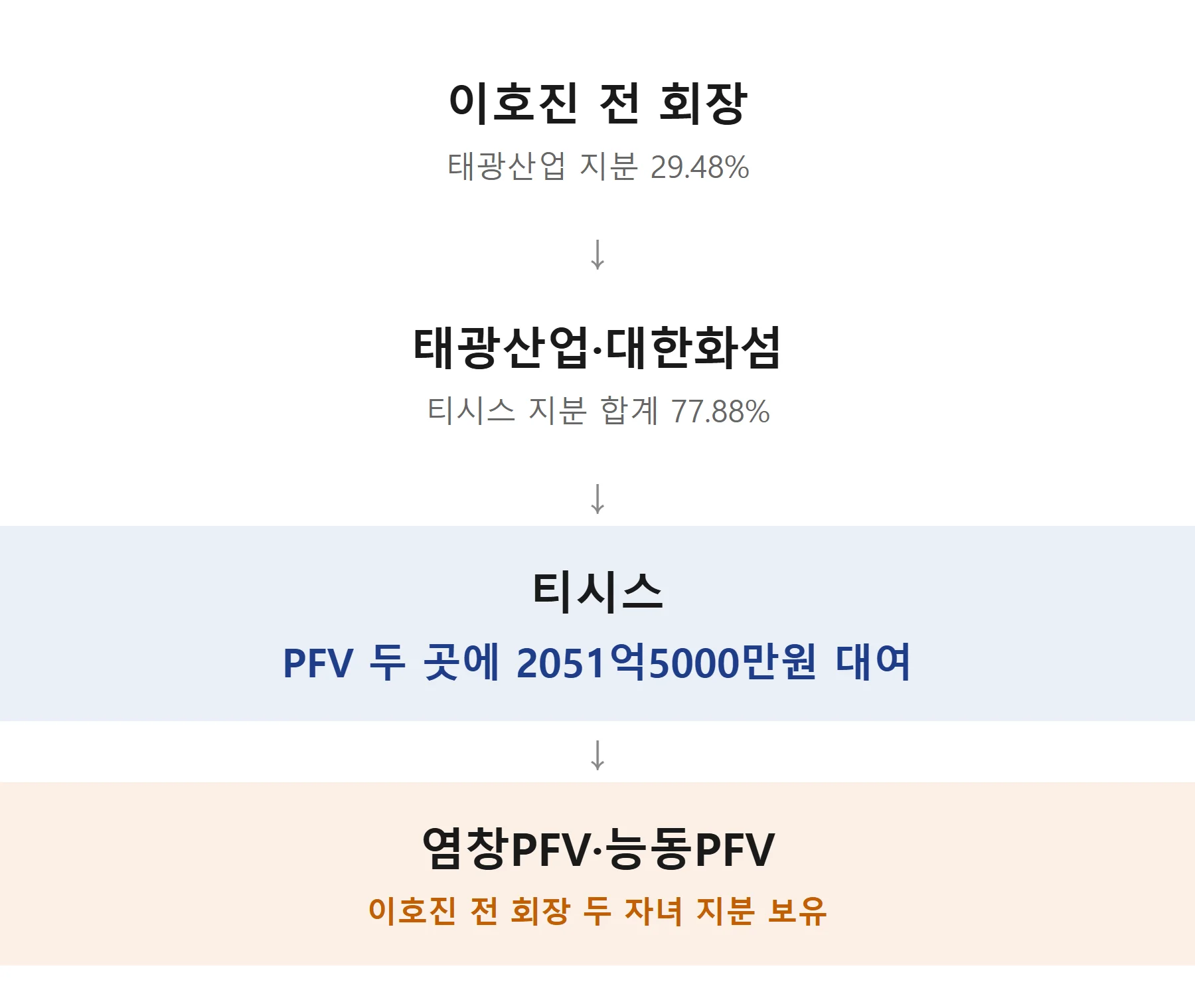
Tsis Also Lent 60 Billion Won for Neungdong Land Acquisition… Additional 19 Billion Won Lent to Yeomchang in August
Solidarity for Economic Reform has requested an investigation by the Korea Fair Trade Commission into two Taekwang Group real estate development companies in which the two children of former Taekwang Group Chairman Lee Ho-jin participate as shareholders.
Taekwang affiliates have lent the two companies 255.15 billion won, approximately 90 times the 2.85 billion won invested by Lee’s two children.
According to the Financial Supervisory Service’s electronic disclosure system and Solidarity for Economic Reform on the 17th, the companies questioned by the organization are Tsis Yeomchang PFV and Tsis Neungdong PFV, which are pursuing residential housing developments in Yeomchang-dong, Gangseo-gu, and Neung-dong, Gwangjin-gu, Seoul. A PFV is a project-financing investment company established for a single real estate development project. Lee Hyun-joon and Lee Hyun-na, children of the former chairman, together hold 19% of the total shares in each company. The largest shareholder of both companies is Tsis, a Taekwang Group affiliate engaged in real estate management and construction, in which Taekwang Industrial and Daehan Synthetic Fiber together hold a 77.88% stake.
Solidarity for Economic Reform argued that because real estate development is closely related to Tsis’s existing business and Taekwang Industrial also identified real estate development as a new business in July last year, the opportunity to acquire these stakes should have belonged to group affiliates. In Tsis Dosan Park PFV, established in April this year, only Taekwang Industrial (68.42%) and Tsis (31.58%) hold common shares. The organization said no explanation had been provided for why the two children needed to invest specifically in the Yeomchang and Neungdong projects.
As of the end of June this year, Lee Ho-jin was the largest shareholder of Taekwang Industrial, with a 29.48% stake, and the controlling individual designated by the Korea Fair Trade Commission for the Taekwang business group. His two children also hold stakes in Tsis: 11.30% for Lee Hyun-joon and 0.55% for Lee Hyun-na.
■ Tsis Financed Both the 60 Billion Won for Neungdong Land and the Additional 19 Billion Won for Yeomchang
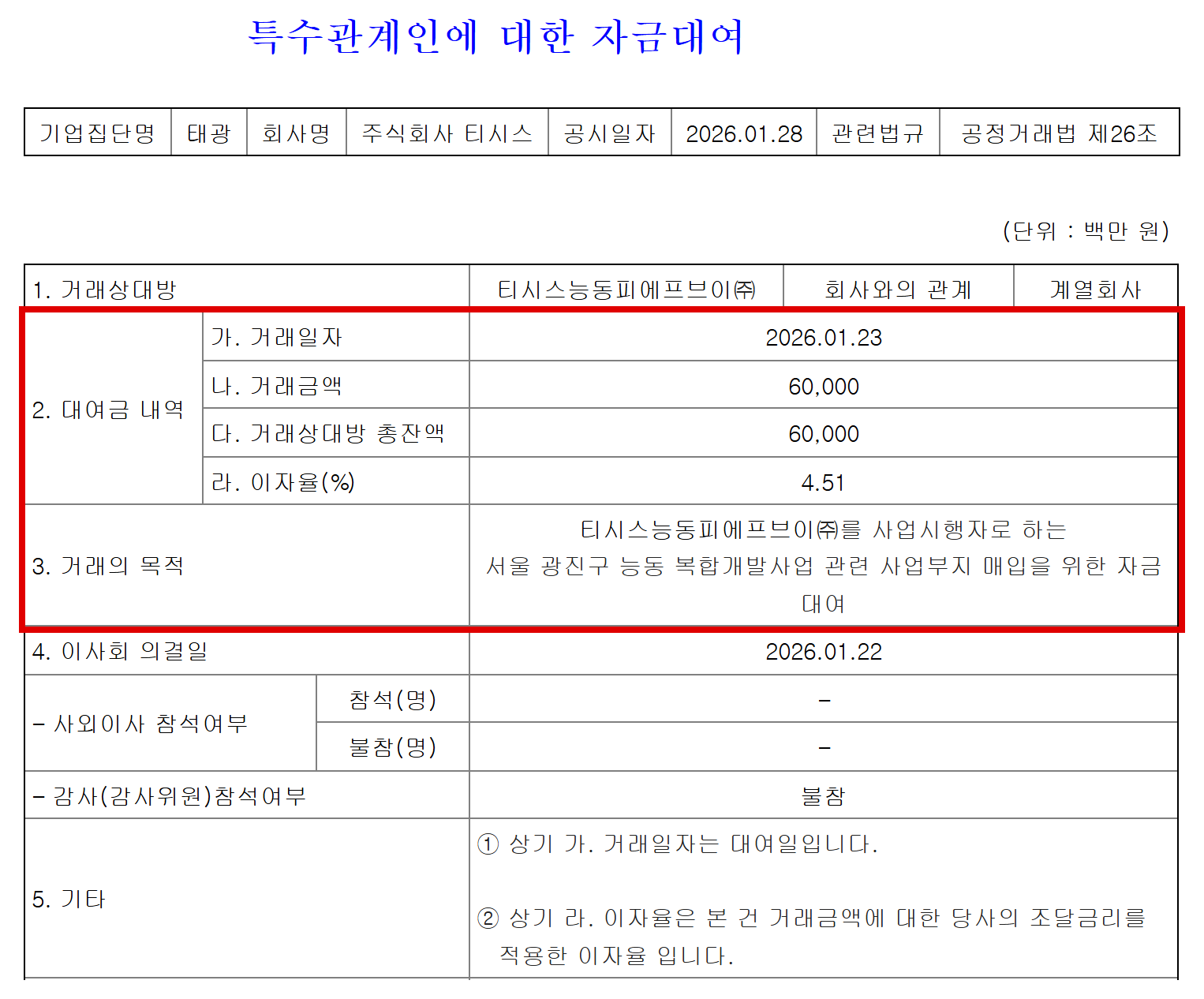
Solidarity for Economic Reform said that Neungdong PFV’s development site and financing structure could not be verified from publicly available materials. However, on January 23, Tsis lent Neungdong PFV 60 billion won for the acquisition of land for the Neungdong mixed-use development project and disclosed the transaction as a large-scale intragroup transaction. The amount matches the approximately 60 billion won acquisition price of the Neungdong site calculated by Korea Investors Service.
For Yeomchang PFV, the affiliate loans questioned by Solidarity for Economic Reform totaled 176.15 billion won, comprising 126.15 billion won from Tsis and 50 billion won from Heungkuk Life Insurance and Heungkuk Fire & Marine Insurance. Tsis subsequently lent another 19 billion won on August 27, increasing its outstanding loan balance to 145.15 billion won. At the end of last year, Yeomchang PFV had borrowings of 284.15 billion won and a debt-to-equity ratio of 2,928%.
Based on a calculated value of 10,000 won per share, obtained by dividing the two companies’ capital—10 billion won for Yeomchang and 5 billion won for Neungdong—by their respective numbers of shares, the two children’s investments amount to 1.9 billion won in Yeomchang and 950 million won in Neungdong. As of July this year, each child held 10% of Yeomchang PFV’s common shares and 12.66% of Neungdong PFV’s common shares.
The annual lending rates were 4.4% to 4.6% for Tsis and 5.4% for the two insurance companies. Tsis said it applied either an overdraft lending interest rate or its own funding rate. Solidarity for Economic Reform pointed out that if the projects failed, Tsis and the financial affiliates that provided the loans would bear the losses, while if the projects succeeded, the two children would also receive development profits in proportion to their ownership stakes.
No outside directors attended the board meetings at which Tsis approved the loans to Neungdong PFV in January and Yeomchang PFV in August, and the auditor was absent. The decision-making process through which PFV shares were allocated to the two children has not been disclosed.
Article 47 of the Monopoly Regulation and Fair Trade Act prohibits companies from providing business opportunities that would confer substantial benefits on a business group owner or their relatives. In June last year, the Supreme Court held in the SK Siltron case that the provision of a business opportunity could be established even when a company voluntarily relinquished the opportunity. However, in that case, the Supreme Court upheld the lower court’s ruling overturning the sanctions imposed by the Korea Fair Trade Commission.
Solidarity for Economic Reform also requested an investigation in October last year into the two children’s acquisition of stakes in T2 Private Equity and Heungkuk REITs Management. The organization pointed out that, while no subsequent action by the Korea Fair Trade Commission had been confirmed, Taekwang had extended the same approach to development projects and increased the children’s ownership stakes. The 150 billion won that Yeomchang PFV borrowed from three group affiliates in November last year is due to mature on November 26 next year.