
Dispute Over ‘345kV Extra-High-Voltage’ Power Lines Spreads to Samsung Electronics’ Yongin Industrial Complex…Environmental Groups to Request Public-Interest Audit on the 17th
English translation of the original Korean report. Images and source documents may contain Korean text.

The dispute surrounding the Yongin Semiconductor National Industrial Complex, where Samsung Electronics plans to build semiconductor factories, is spreading to a 345kV (kilovolt) extra-high-voltage power transmission network.
Environmental groups will request a public-interest audit by the Board of Audit and Inspection on the 17th, arguing that the development of the industrial complex and the construction of transmission and substation facilities to supply it with electricity have proceeded without feasibility assessments.
According to the Korean Federation for Environmental Movements on the 12th, the organization is gathering petitioners through the 15th. A public-interest audit by the Board of Audit and Inspection can be requested when at least 300 citizens aged 18 or older sign together, so the organization has set its recruitment target at 300.
The audit request will cover ‘the overall development project for the Yongin Semiconductor National Industrial Complex’ and ‘the construction project for 345kV extra-high-voltage transmission and substation facilities related to the project.’ The organization will hold a joint press conference at 11 a.m. on the 17th in front of the Board of Audit and Inspection, headed by Chairman Kim Ho-chul, in Jongno-gu, Seoul, and submit the petition.
The organization claimed that the project was ‘being pushed forward hastily’ at every stage, from site selection and electricity supply planning to transmission network construction. It argued that while industry and electricity demand are concentrated in the Seoul metropolitan area, residents of other regions bear the burden of power plants and transmission towers.
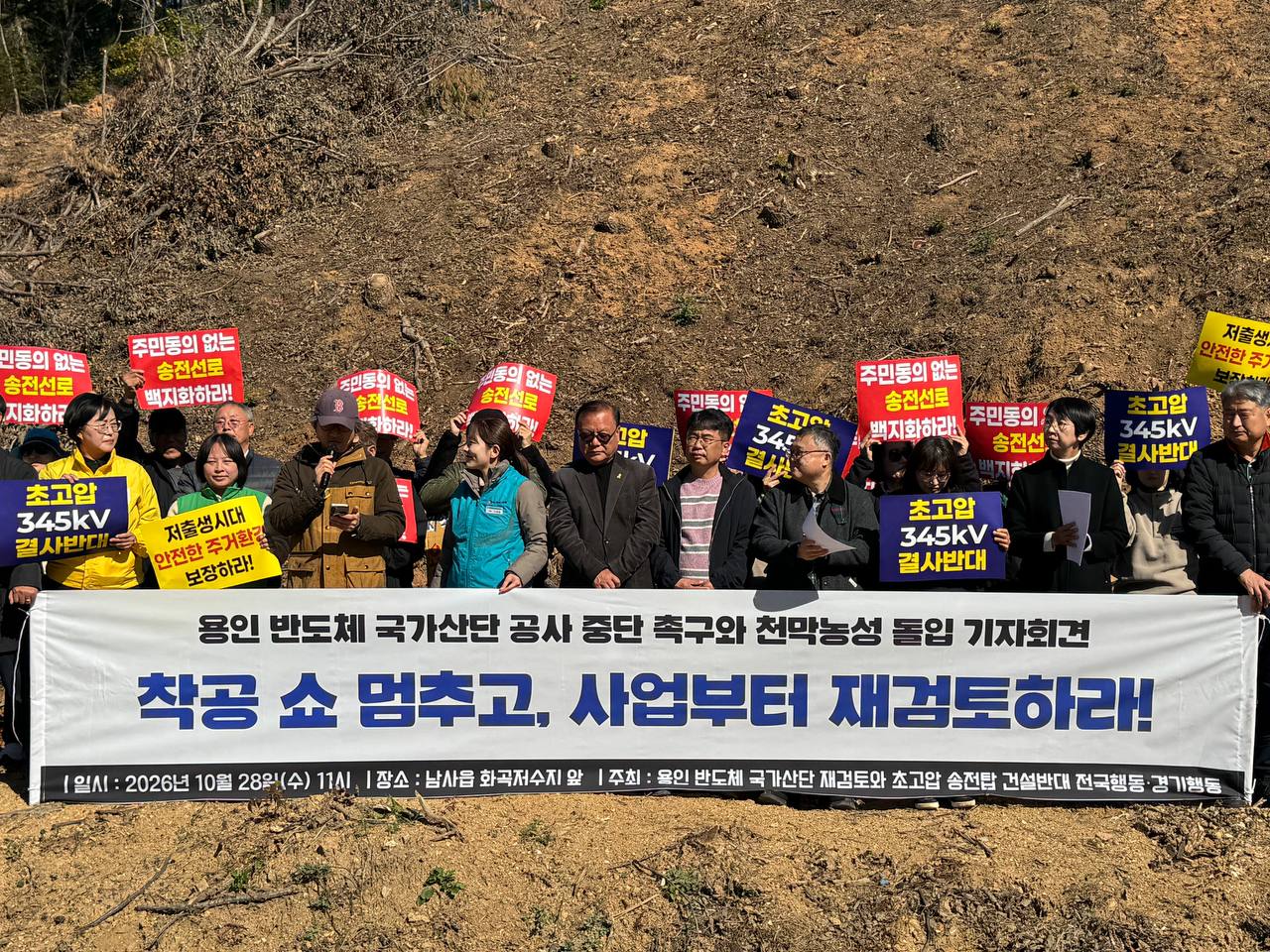
At a press conference on the 28th of last month, the Nationwide Action for Reconsideration of the Yongin Semiconductor National Industrial Complex and Opposition to Extra-High-Voltage Transmission Tower Construction claimed that supplying electricity to the industrial complex could trigger disputes over transmission lines in 55 areas nationwide.
The industrial complex will cover 7.77 million square meters across Idong-eup and Namsa-eup in Cheoin-gu, Yongin, Gyeonggi Province, where Samsung Electronics plans to invest KRW 360 trillion to build six semiconductor fabrication plants (fabs). The Ministry of Land, Infrastructure and Transport approved the industrial complex plan on December 31, 2024, and Korea Land and Housing Corporation (LH), headed by President Seong-Hoon Lee, took responsibility for the project.
On the 28th of last month, LH began site preparation work on the 3.45-million-square-meter Section 1, where the first fab will be located. Construction costs are approximately KRW 1.086 trillion, and the target is to begin construction of the first fab in 2028.
The source of the industrial complex’s electricity supply was determined long after its approval. It was not until August 12 of this year, one year and seven months after the approval, that the government announced an agreement setting out the industrial complex’s overall electricity demand and supply arrangements.
According to the agreement, electricity demand from the national industrial complex and the Wonsam General Industrial Complex, where SK hynix will be located, will reach at least 14GW (gigawatts) by 2041. The national industrial complex will meet its initial demand through three 1GW liquefied natural gas (LNG) power plants and nearby transmission lines by 2032. Transmission and substation facilities rated at 345kV or above fall under the category of ‘national backbone power grid’ covered by the Special Act on the Expansion of the National Backbone Power Grid, which took effect in September last year.
■ Matters Under Litigation and Major Policies Excluded From Audits…Key Issue Is ‘Errors in Supporting Data’
The legality of the industrial complex’s approval is already before the courts. Activists from Solutions for Our Climate and local residents filed a lawsuit against the Ministry of Land, Infrastructure and Transport seeking to overturn the approval. The plaintiffs argued that the assessment considered only greenhouse gas emissions from the 3GW of power generation within the industrial complex, while excluding indirect emissions associated with the 7GW of electricity to be supplied from outside.
On January 15 of this year, the 14th Administrative Division of the Seoul Administrative Court dismissed all the plaintiffs’ claims, finding that although the climate change impact assessment had ‘some shortcomings,’ they were not serious enough to be equivalent to having conducted no assessment at all. The court reasoned that administrative authorities should be afforded broad discretion in judgments requiring predictions about the future. The plaintiffs appealed.
A public-interest audit request faces two hurdles. Such an audit may be requested when the affairs of a public institution are unlawful or ‘improper’ and harm the public interest, but the Board of Audit and Inspection’s regulations on handling public-interest audit requests exclude matters subject to ongoing litigation or other appeal procedures.
The Board of Audit and Inspection may therefore decline to examine the legality of the industrial complex’s approval itself, which is currently before the Seoul High Court. Major policies adopted by the state through a reasonable decision-making process are also excluded in principle.
However, an audit may be conducted if there are errors in facts or materials that served as important criteria for the decision. The key to determining whether an audit will proceed is therefore whether the underlying data used for electricity demand and supply planning contained errors in the transmission and substation construction project, which is not the subject of the lawsuit challenging the industrial complex’s approval. For audit requests concerning major national policies, the Secretary General of the Board of Audit and Inspection determines whether to conduct an audit after consulting the Public-Interest Audit Request Advisory Committee.
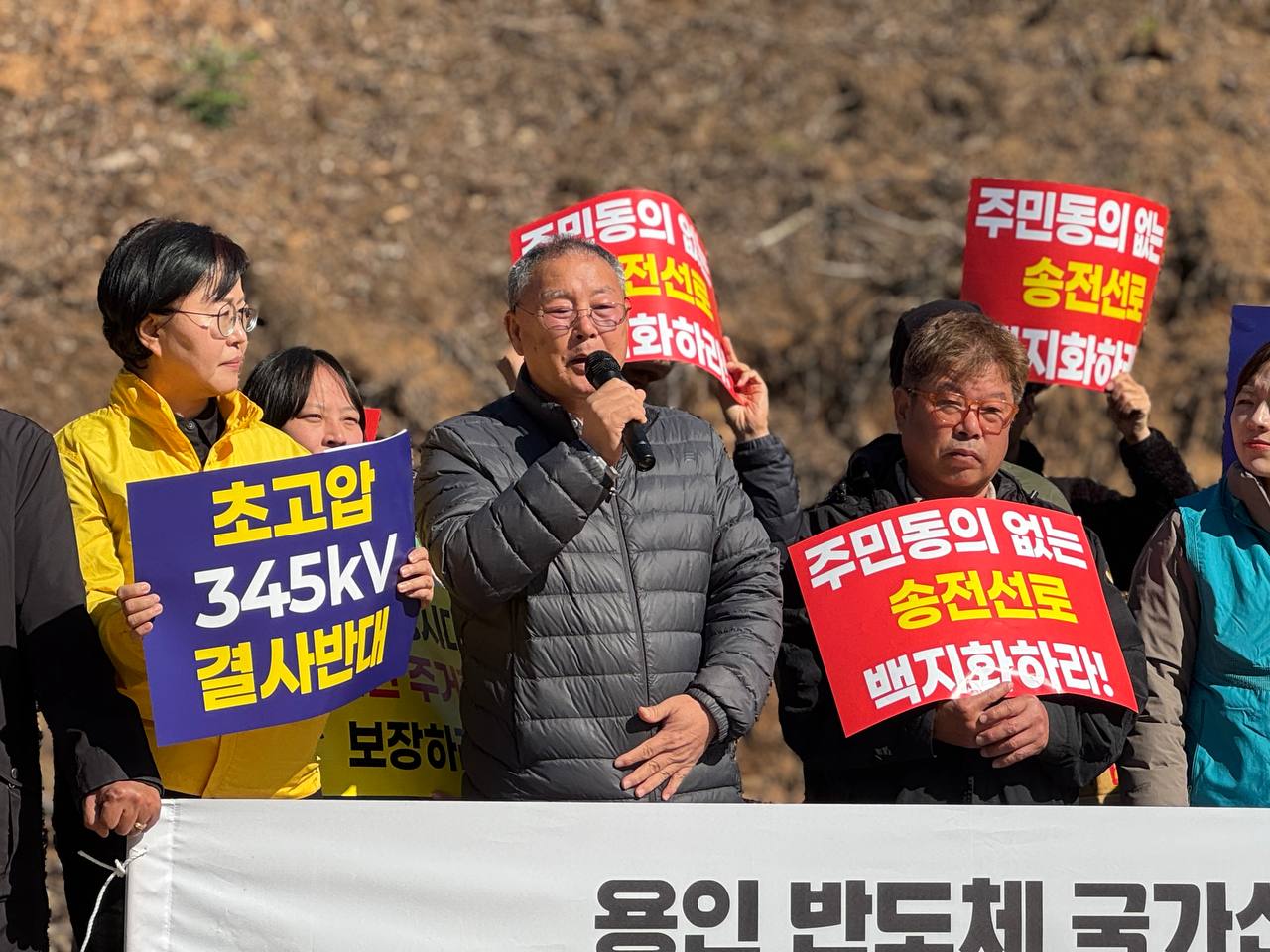
Construction work and a protest encampment began at the site on the same day. On the 28th of last month, when LH began construction work on Section 1, the nationwide coalition set up a protest tent at the project site. The coalition demanded a halt to construction and public dialogue, arguing that LH had acquired only 43% of the land through negotiated purchases and that relocation measures for 89 existing businesses were also inadequate. LH stated that it had completed compensation procedures for 99% of privately owned land.