
KB Life of Jeong Moon-chul’s insurance contracts have exceeded 30% in the second year… Recovery last year was a temporary rebound when term life insurance was heavily sold
English translation of the original Korean report. Images and source documents may contain Korean text.

2-year retention rate from January-September this year is 67.8%… The company cited a booming stock market, but the subsidiary’s agents’ organization increased
More than 30% of insurance contracts are terminated before two years at KB Life, led by CEO and President Jeong Moon-chul. The 2-year retention rate from January-September this year is 67.8%, meaning the remaining 32.2% were not retained. Although the retention rate rose to the 80% range last year, it was only for two quarters when term life insurance was heavily sold.
According to KB Financial Group’s fact book on September 5, the 2-year retention rate (25th premium payment rate) is a number showing how many contracts remain after about two years of insurance. It is used as an indicator to gauge how well an insurance company retains customers.

KB Life’s figure has been above 80% only twice in the 15 quarters since 2023, in Q2 and Q3 last year, and in 11 quarters it was below 70%. The retention rate was 83.3% in Q3 last year, but dropped to 64.3% in the following quarter, and was 71.1% in Q3 this year.
The 2-year retention rate reflects the performance of contracts sold two years ago. KB Life concentrated on selling term life insurance in 2023. 81.0% of new insurance sold in that year from March to August was term life insurance. Monthly sales (converted to annual premium) increased to 10.39 billion won in August, but dropped sharply to 360 million won in September. In January-September 2024, the share of term life insurance decreased to 6.9%, while savings-type insurance such as annuities accounted for 70.2%.
The retention rate also moved in the same way two years later. The 80% range in Q2 and Q3 last year was the performance of contracts from Q2 and Q3 2023, when term life insurance was heavily sold, and from Q4 last year, when term life insurance sales decreased. It is not mentioned in the fact book how many contracts left from which products.
■ Contracts are maintained in the first year but lost in the second year
The 1-year retention rate is not bad. It was 93.4% in the third quarter, the highest since 2023. The problem is the second year. The difference between the 1-year retention rate and the 2-year retention rate, based on cumulative figures from January to September, was 10.7 percentage points last year (91.6%→80.9%), but this year it widened to 20.0 percentage points (87.8%→67.8%).
In this regard, KB Life explained, ‘We believe changes in the financial environment, such as a booming stock market, have influenced it.’ It also said that there are limitations to simple comparisons, as the indicator varies depending on the sales timing and product composition. However, it is difficult to explain solely by the stock market impact. According to the analysis of the first-half 2024 disclosures by Insurance Journal, the 2-year retention rate of life insurance from KB Life Partners, the subsidiary’s agent organization, increased from 80.26% to 86.31%, while KB Life’s rate dropped from 79.6% to 65.5% during the same period. Although the criteria for statistics differ, the direction is opposite.
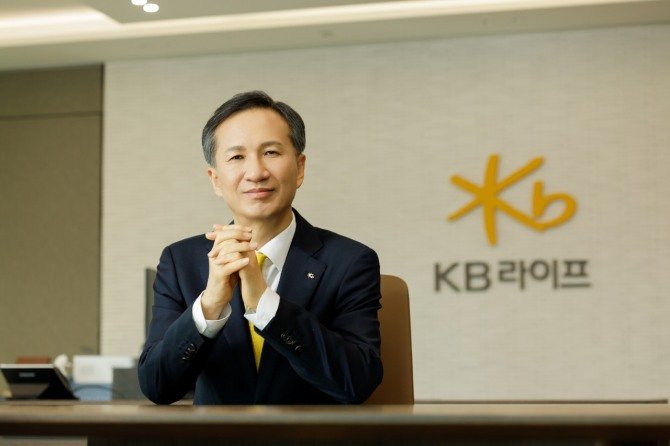
Retention rate is part of the performance evaluation of the CEO. KB Life’s business report includes the retention rate as an evaluation item for the remuneration of appointed directors. The contracts evaluated this year were mainly sold in 2024, when Lee Hwan-joo was the current CEO of KB Kookmin Bank. Jeong took office in January 2025 and has been managing these contracts. KB Life is a subsidiary of KB Financial with 100% ownership, and there is no individual owner.
If contracts are terminated, the profits the insurance company will make in the future will also decrease. According to KB Life’s business report, when the lapse rate increases by 9.16%, the insurance contract margin (CSM), which represents future profits, decreases by 33.64 billion won, which is 10.3% of the balance at the end of last year. However, this calculation assumes all existing contracts, and does not mean that this decline will result in the same amount of loss.
Jeong’s term ends on December 31. Jeong is also mentioned as a candidate for the next CEO of KB Kookmin Bank. Whether the contracts that recorded a 93.4% retention rate this year will remain for the second consecutive year will be revealed in the fact book in the third quarter of next year.