
Samsung Electronics DX Division Head Roh Tae-moon’s first-half compensation 7.4 billion won…Finished products division records 800 billion won deficit. Union asks, “Who takes responsibility for management decisions?”
English translation of the original Korean report. Images and source documents may contain Korean text.
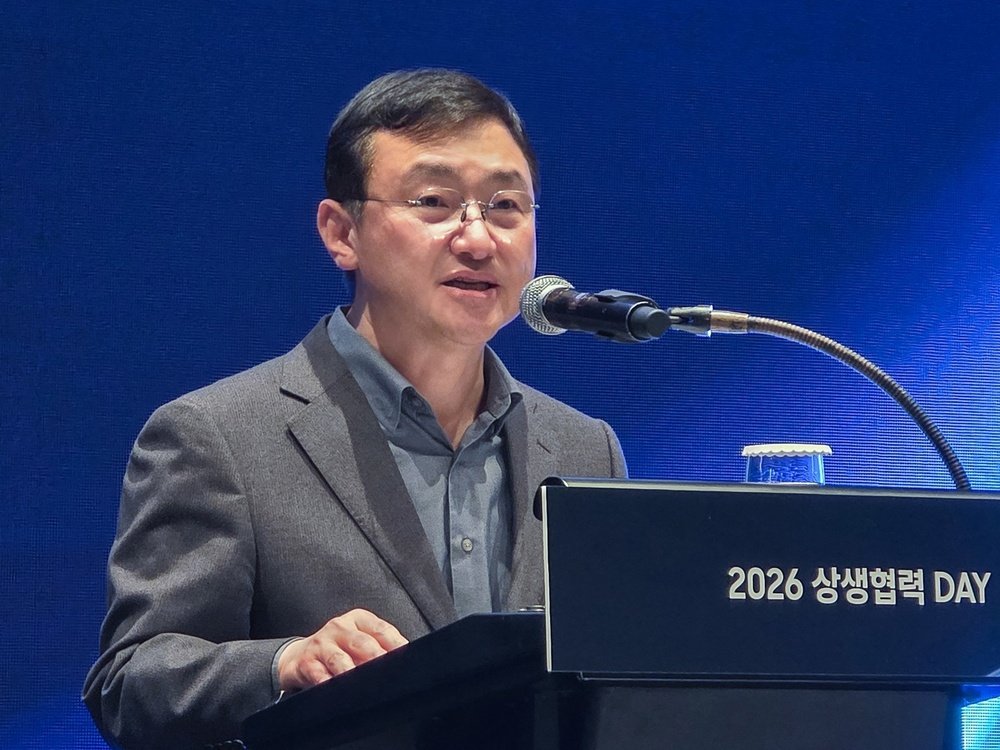
The labor union ‘Samsung Electronics Labor Union Donghaeng,’ centered on employees of Samsung Electronics’ finished products (DX) division, will hold a general assembly at the Suwon business site on the upcoming 5th.
The company exceeded 100 trillion won in operating profit for the third quarter for the first time, but the DX division, led by CEO and President Roh Tae-moon, recorded an operating loss of 800 billion won. Donghaeng’s position is to demand accountability for the management decisions that led to this deficit and to seek compensation for DX employees.
According to Donghaeng on the 3rd, the rally will be held in front of the central gate of the Suwon business site from 5 PM to 7 PM on the 5th. A preliminary event will take place at 4:40 PM. At this event, Donghaeng plans to demand three things: an official apology for the controversy surrounding the exclusion of DX from the 2026 wage negotiations, cash-based compensation reflecting the contributions of DX employees, and the establishment of a joint negotiation system for 2027 involving DX.
According to Samsung Electronics’ disclosure on the 29th of last month, consolidated sales for the third quarter were 195.25 trillion won, and operating profit was 107.44 trillion won, both record highs. The DS division, which manufactures semiconductors, recorded sales of 147.1 trillion won and an operating profit of 106.5 trillion won. This means 99% of the company’s total operating profit came from semiconductors.
On the other hand, the DX division, which manufactures smartphones, TVs, and home appliances, recorded sales of 52.1 trillion won and an operating loss of 800 billion won. Donghaeng pointed out that DX sales increased by 8% compared to the previous quarter, yet still incurred a deficit.
The company cited cost burden as the reason. In its earnings announcement, Samsung Electronics stated regarding its mobile (MX) business that there was “an increase in cost burden due to rising memory prices.” It explained that while home appliance sales were strong, profits decreased due to rising raw material and logistics costs.
Donghaeng took issue with this explanation. It argued that memory supply shortages and price increases were already anticipated in the market. Donghaeng asked, “Given the anticipated rise in memory prices, what sales pricing policies and profitability strategies did management establish?” and demanded disclosure of how much of the cost increase was reflected in product prices.
Donghaeng also emphasized that DS and DX operate within a structure where components are manufactured within one company, and finished products are sold using those components. It argued that the contribution of DX’s finished product sales to the component business should also be evaluated in compensation. Donghaeng retorted, “Should sales expansion be decided by management, while the burden of rising costs falls on employees?”
■ In the year semiconductors generated 99% of profits, DX employees’ share was 6 million won worth of treasury shares.
The conflict began during wage negotiations in May this year. The company and the enterprise-wide union, which is the representative negotiating union, created a provisional agreement, and Donghaeng members were excluded from the vote. The agreement included providing 6 million won worth of treasury shares per DX employee. Donghaeng has raised concerns about the disparity, stating that under the same agreement, memory business division employees could receive up to 500 million to 600 million won.
Donghaeng filed an injunction with the court, arguing that their exclusion from the vote was unfair, but it was not accepted. On June 23, Civil Division 31 of the Suwon District Court dismissed and rejected the application, ruling that Donghaeng had already withdrawn from the joint negotiation team at the time of the vote. The court determined that even if all approximately 12,000 Donghaeng members had opposed it, the agreement would still have passed, as the approval rate was approximately 59%.
Since then, Donghaeng has continued rallies in front of the Suwon business site in July and near Chairman Lee Jae-yong’s residence in September, demanding direct dialogue with management. At this rally, a legal expert will lecture on the representative negotiating union’s duty of fair representation, and speeches from on-site employees will also follow.
Donghaeng claimed that as work efficiency and cost reduction using AI are emphasized in the DX division, concerns about voluntary retirement and job transfers are also growing. It questioned whether it is fair to demand only sacrifice and efficiency from employees without explaining management decisions.
The management of the DX division is handled by CEO and President Roh Tae-moon. President Roh also concurrently serves as the head of the MX business division, which is responsible for mobile. Samsung Electronics first announced President Roh’s appointment as CEO when it announced its executive reshuffle on November 21 last year. The board of directors processed the agenda item to appoint President Roh as CEO a week later, on November 28. According to the business report, the board of directors at that time consisted of 9 members, including 6 outside directors, such as Chairman Shin Je-yoon, and 3 inside directors, and this agenda item was passed without opposition.
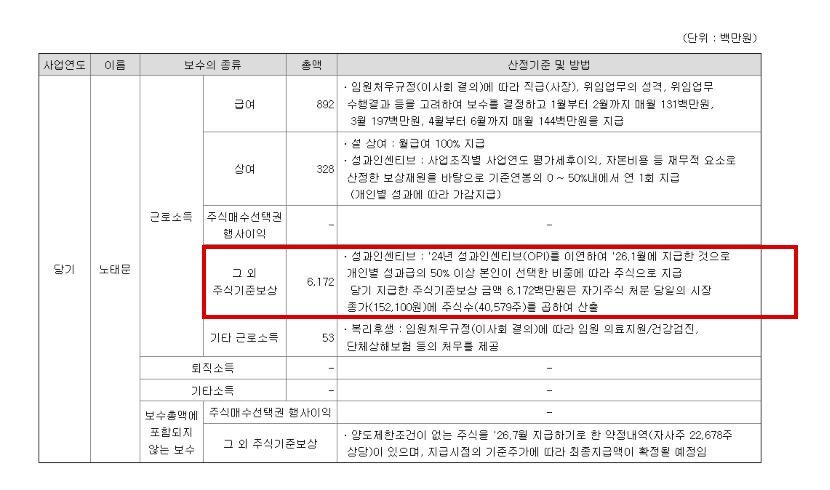
According to the semi-annual report, President Roh received 7.445 billion won in compensation for the first half of this year. This includes 892 million won in salary, 328 million won in bonuses, 6.172 billion won in stock compensation, and 53 million won in welfare benefits. The company stated that the salary was determined “considering the position (President), the nature of the delegated duties, and the results of performing the delegated duties” in accordance with the executive compensation regulations set by the board of directors. The monthly salary increased from 131 million won in January-February to 144 million won starting in April.
The 6.172 billion won, which accounted for 83% of the compensation, is the 2024 performance incentive (OPI). The company explained that it deferred the payment of this performance bonus and then provided it in January this year as 40,579 treasury shares. The amount was calculated by multiplying the number of shares by the closing price of 152,100 won on the payment date. OPI is paid within 0-50% of the base annual salary, with funds determined by “financial factors such as evaluated after-tax profit and cost of capital” for each business organization. Separately, President Roh was contracted to receive 22,678 treasury shares as long-term incentive (LTI) in July.
At the apex of Samsung Electronics’ governance structure is Chairman Lee Jae-yong. Chairman Lee is a full-time employee and the individual with the largest stake, but he is an unregistered chairman, not a registered director. As he is not a member of the board of directors, he did not participate in the vote to elect President Roh as CEO.
Chairman Lee’s control is linked through a chain of shareholdings. As of the end of June, Samsung Electronics’ largest shareholder is Samsung Life Insurance (8.51%), Samsung Life Insurance’s largest shareholder is Samsung C&T (19.34%), and Samsung C&T’s largest shareholder is Chairman Lee (22.01%). Chairman Lee and his related parties collectively hold 19.84% of Samsung Electronics’ common shares, and of this, Chairman Lee’s personal share is 1.67%.
Along with its third-quarter earnings, Samsung Electronics decided on a quarterly dividend of 4,601 won per share, totaling 30 trillion won. Calculated based on Chairman Lee’s shareholdings at the end of June, the amount he will receive from this quarterly dividend is approximately 448.8 billion won.
Regarding the DX division’s plans for the fourth quarter, Samsung Electronics stated, “We plan to focus on securing profitability by expanding sales of premium products during the year-end peak season.” The MX business division said it “plans to defend profitability by streamlining processes” while increasing sales. The sales expansion and efficiency improvements that Donghaeng vowed to challenge at the rally are precisely included in the company’s next quarter’s plans.