
Bando E&C Gyeyang Sales Announcement: “Sales Price Exceeds Nearby Transaction Price”…No Response to Inquiries
English translation of the original Korean report. Images and source documents may contain Korean text.
Down Payment 5%, Balance 35%, Different from Comparison Complexes…No Answer Even When Asked About the Authenticity of the ‘Birak Sikhye Bottle Exterior Wall’ Photo
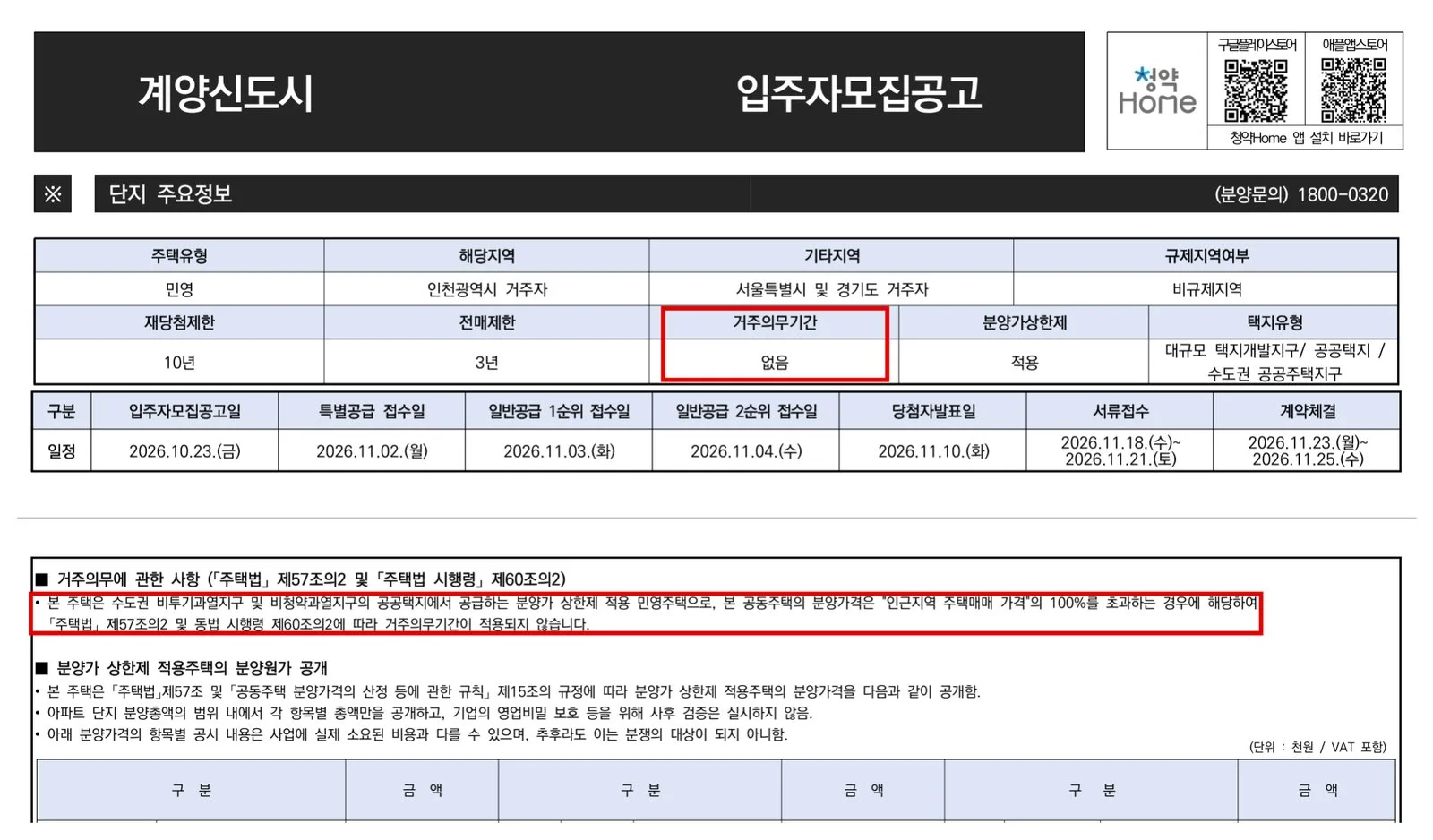
As the supply of apartments under the housing price cap system continues in Incheon’s public land, sales prices and contract conditions vary significantly even among complexes under the same cap system. Bando E&C’s 1,110 units in Gyeyang New Town, which received subscriptions this month, stated in their resident recruitment announcement that the sales price “exceeds 100% of the housing transaction price in the nearby area.”
Comparing the resident recruitment announcements of each complex on the 3rd, Bando E&C’s complex is a housing unit built on public land under the housing price cap system (a system that sets sales prices within government standards), but it does not come with a mandatory residency requirement. The announcement cited the reason that the sales price exceeds 100% of the transaction price of nearby housing.
The mandatory residency requirement, which is attached to capped-price housing supplied cheaper than the surrounding market price, was omitted because the sales price exceeded the market price. In the public sales announcements for Geomdan Jungheung S-Class and Paragon, and Gyeyang A6 Block public housing, all located on the same Incheon public land, the mandatory residency requirement is also stated as ‘none’.
Contract conditions also differ from comparison complexes. Bando E&C’s complex has a down payment of 5%, intermediate payment of 60%, and balance of 35%. Jungheung E&C’s Geomdan Lake Park Station Jungheung S-Class, Dongyang Construction Industrial’s Geomdan Lake Park Station Paragon, and LH’s Gyeyang A6 Block all require a 10% down payment. The balance for the two Geomdan complexes is 30%.
Although the down payment threshold is low, the amount to be paid upon move-in is large. For a house with a maximum price of 826 million won for 84㎡ exclusive use area, 41.3 million won is paid at contract signing, and 289.1 million won is paid as the balance upon move-in. Based on the highest price for the same area, the balance for Jungheung S-Class is 185.1 million won, and for Paragon, it is 193.5 million won. Due to the high sales price and a 5 percentage point higher balance ratio, the difference widens to around 100 million won.
Intermediate payments are subject to a deferred interest payment system. The project owner pays the intermediate loan interest until move-in, and the contractor must repay this interest all at once when paying the balance. If loan arrangements are blocked, the contractor must secure the intermediate payment themselves. This method and wording are also included in the Jungheung S-Class announcement.
The sales price itself is also higher than comparison complexes. Bando E&C’s complex’s highest supply price of 826 million won for 84㎡ is 109.46 million won higher than the public sale of Gyeyang New Town A6 Block (716.54 million won), and 181 million to 209 million won higher than Geomdan complexes by construction companies with similar construction capability evaluation rankings. As the sales timing, location, and design differ, not all differences can be attributed to differences in quality or brand.
The scheduled move-in date is August 2029, similar to A6 Block (June 2029), and one year later than Jungheung S-Class (August 2028), which was sold last year.
The contractor’s sales payment is guaranteed by the Housing and Urban Guarantee Corporation (HUG). According to the announcement, sales payments are only received into HUG-named accounts, and if the project owner goes bankrupt or becomes insolvent, HUG replaces the project owner. However, there is also a clause stating that in this case, the contractor may have to bear the intermediate payment interest that the project owner was paying. This clause is also present in announcements for other private complexes.
■ Online ‘Birak Sikhye Bottle Exterior Wall’ Controversy…No Answer to Quality Inquiries
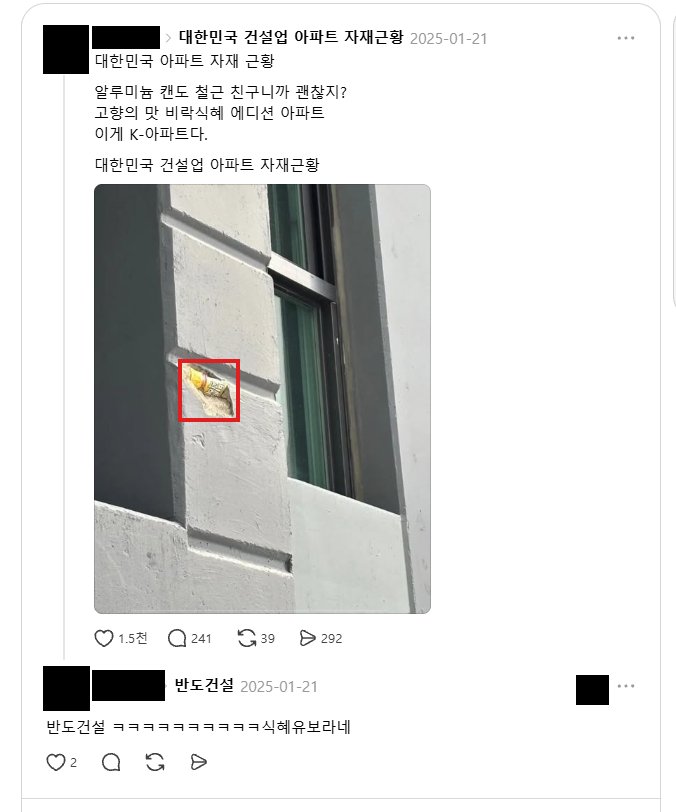
Quality controversies regarding Bando E&C have also continued online. In the so-called ‘Birak Sikhye bottle exterior wall’ photo that spread in January last year, an object resembling a Birak Sikhye plastic bottle was exposed where the building’s exterior wall surface had peeled off, and some posts identified an officetel in Pyeongtaek constructed by Bando E&C as the filming location. The actual filming location and cause of the incident have not been confirmed.
Ahead of the new complex’s contract, to confirm this controversy and quality control measures, Newsfield asked Bando E&C on the 2nd whether the building in the photo was an actual construction site, and if so, what the cause and repair results were. The results of the Pyeongtaek officetel sales advertisement lawsuit and the quality inspection procedures at the Gyeyang site were also inquired about. Bando E&C did not respond for two days.
Bando E&C is led by co-CEOs Kim Yong-cheol and Lee Jeong-ryeol, and its holding company, Bando Holdings, owns 100% of the shares. The largest shareholder of Bando Holdings is Kwon Hong-sa, chairman of the Bando Cultural Foundation, who holds a 69.61% stake and is considered the same person effectively controlling the group under the Fair Trade Act.