
Huwons, recalls 6.63 million artificial tears in the US… Again just half a year after injection drug recall
English translation of the original Korean report. Images and source documents may contain Korean text.
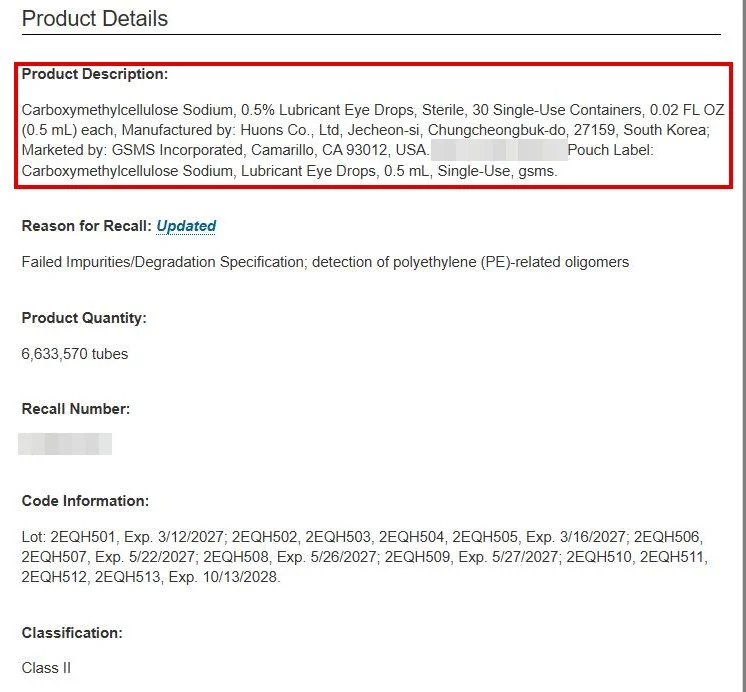
Huwons, known for the lidocaine topical anesthetic and hyaluronic acid eye drops ‘Kainix,’ is voluntarily recalling 6.6 million disposable artificial tears exported to the US.
The US Food and Drug Administration (FDA) classified this recall as a second-level recall. It is another quality recall in the US, just half a year after the company recalled its injectable drugs exported to the US over sterility issues.
According to the FDA drug recall information (Enforcement Report) on the 4th, ‘Carboxymethylcellulose Sodium 0.5% Artificial Tears’ made by Huwons and sold by GSMS in the US has been listed as a recall item.
This is a different product from Kainix. It includes 6,633,570 single-use containers of 0.5mL, with 13 batches of manufacturing numbers. The expiration dates range from March 2027 to October 2028, and it has been distributed throughout the US.
The reason for the recall is ‘non-compliance with impurity and decomposition product standards.’ This means impurities not meeting quality standards were found in the product.
The impurity pointed out by the FDA is a polyethylene (PE) related oligomer. Polyethylene is a material commonly used in plastic bags and plastic containers, and an oligomer is a short piece made by a few small molecules connected together.
The FDA corrected the reason statement on the 3rd. Initially, it stated ‘PE-related extractables exceeded the analytical evaluation threshold (AET),’ but it was changed to ‘PE-related oligomers detected.’ The analytical evaluation threshold is the minimum concentration at which substances that leach out from packaging materials must be separately identified and evaluated.
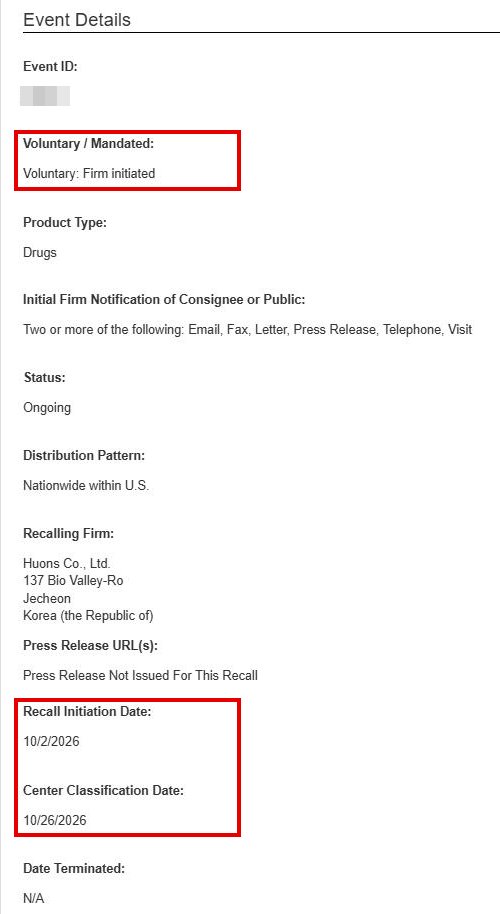
The recall was initiated by Huwons. The start date is October 2, and the FDA classification date is October 26. The FDA defines a second-level recall as one that may cause temporary or recoverable health effects, with a low likelihood of serious harm. The FDA record states that no press release was issued.
Huwons has not issued any announcement regarding this recall.
■ U.S. exports halted after injection recall… Kit recall rated ‘level 1’
Huguen Pharmaceuticals began a U.S. recall of lidocaine, bupivacaine, and normal saline injections on April 2. The reason was ‘insufficient sterility assurance,’ and the FDA classified it as level 2 on May 15. There are four recall numbers, with only one product, 1% lidocaine injection, involving 33.59 million vials and 23.65 million ampoules.
Injections made with this product also led to recalls of anesthetic and procedure kits by U.S. companies. The FDA classified the bupivacaine-containing kit recalls by Medline, BD, and B. Braun as the highest risk level 1. The reason for Medline’s recall includes ‘concerns about microbial test data integrity and reports of insufficient efficacy.’
In the FDA database, the four Huguen Pharmaceuticals injection recalls are still ‘in progress’ with no end date listed.
The impact is also reflected in the financial results. Huguen Pharmaceuticals’ first-half operating profit under separate criteria was 850 million won, down 66% from 2.51 billion won a year earlier. The company also recorded 527.764 million won in sales warranty costs during the same period. The sales warranty reserve, which is set aside for future recall costs, increased from 0 won at the end of last year to 527.764 million won by the end of June.
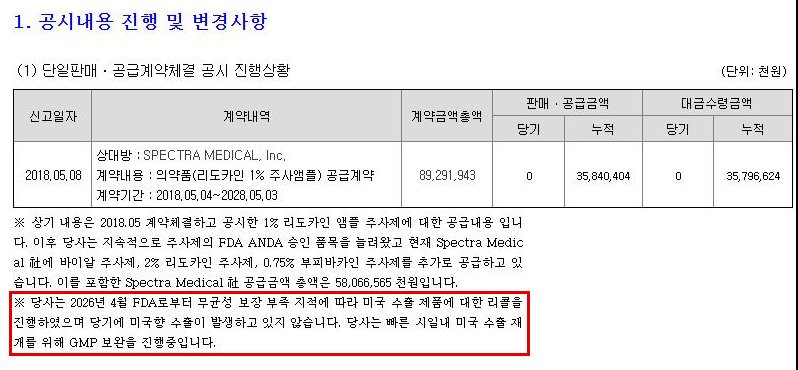
In the semi-annual report, Huguen Pharmaceuticals stated, ‘We conducted a recall of U.S. export products following the FDA’s April 2026 inspection findings of insufficient sterility assurance, and there have been no U.S. exports during this period.’ The total supply amount to U.S. SpectraMedical, which has been receiving injections since 2018, is 58 billion won. The company added, ‘We are currently working on GMP improvements to resume U.S. exports as soon as possible.’
Huguen Pharmaceuticals’ largest shareholder is the holding company Huguen Global, which owns 40.74% of the shares. Huguen Global’s largest shareholder is Yoon Sung-tae, chairman of Huguen Global, who owns 42.76% of the shares. Yoon, the chairman of Huguen Global, serves as an external non-regular director of Huguen Pharmaceuticals, overseeing the group, while Song Soo-young, CEO of Huguen Pharmaceuticals, is the chairman of the board. Yoon In-sang, an internal director, is in charge of overall management and owns 3.38% of Huguen Pharmaceuticals’ shares.
On the 30th of last month, Yoon announced a plan to sell 2.5 million shares (19.75%) of Huguen Global stock to a company he owns 100% through over-the-counter trading. The expected transaction amount is 5.2375 billion won, with the transaction period from the 30th of this month to December 29th. The purpose of the transaction is stated as ‘stabilizing the corporate structure and strengthening responsible management.’
Huguen Pharmaceuticals was also deferred from being designated as an irregular disclosure company by the KOSDAQ Market Division last month. This was due to the company’s withdrawal of the merger with Huguen Lab announced in May, which was later revoked, resulting in a penalty of 7 points.
Huguen Pharmaceuticals noted in its semi-annual report on August 14 that it was working on GMP improvements. The artificial tear recall started 49 days later on October 2. This recall is also marked as ‘in progress’ in the FDA database.