
Hong Kong ELS Penalty: KB Kookmin Bank’s Share is 172.3 Billion Won, Half of Total… Financial Union Points to ‘Management’s Excessive Performance Competition’
English translation of the original Korean report. Images and source documents may contain Korean text.
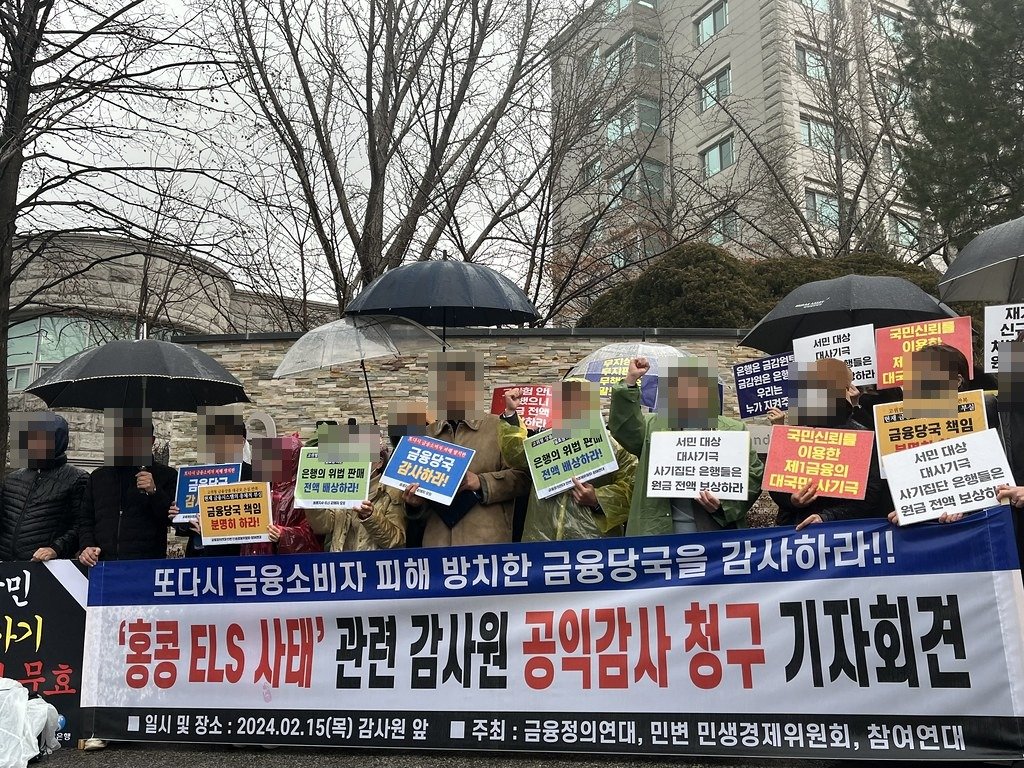
Only 48% of the 360.9 Billion Won in Accumulated Provisions Confirmed… Lee Jae-geun, CEO at the Time of Sale and Compensation, to be Appointed KB Financial Chairman on the 20th
As the penalty for the mis-selling of Hong Kong H-index equity-linked securities (ELS) has been finalized, KB Kookmin Bank will have to pay 172.3 billion won, about half of the total for the banking sector. The Korean Federation of Financial Industry Unions, separate from the reduction in the penalty, demanded that the management’s excessive performance competition be scrutinized.
According to the Financial Services Commission (FSC) on the 4th, the FSC finalized its decision at its 19th regular meeting today to impose a penalty of 361.96 billion won and a fine of 1.778 billion won on seven banks: Kookmin, Shinhan, Hana, Nonghyup, SC First, Woori, and Suhyup Bank. For six securities firms—Mirae Asset, KB, Shinhan Investment, NH Investment, Korea Investment, and Samsung Securities—a penalty of 9.282 billion won and a fine of 1.612 billion won were imposed.
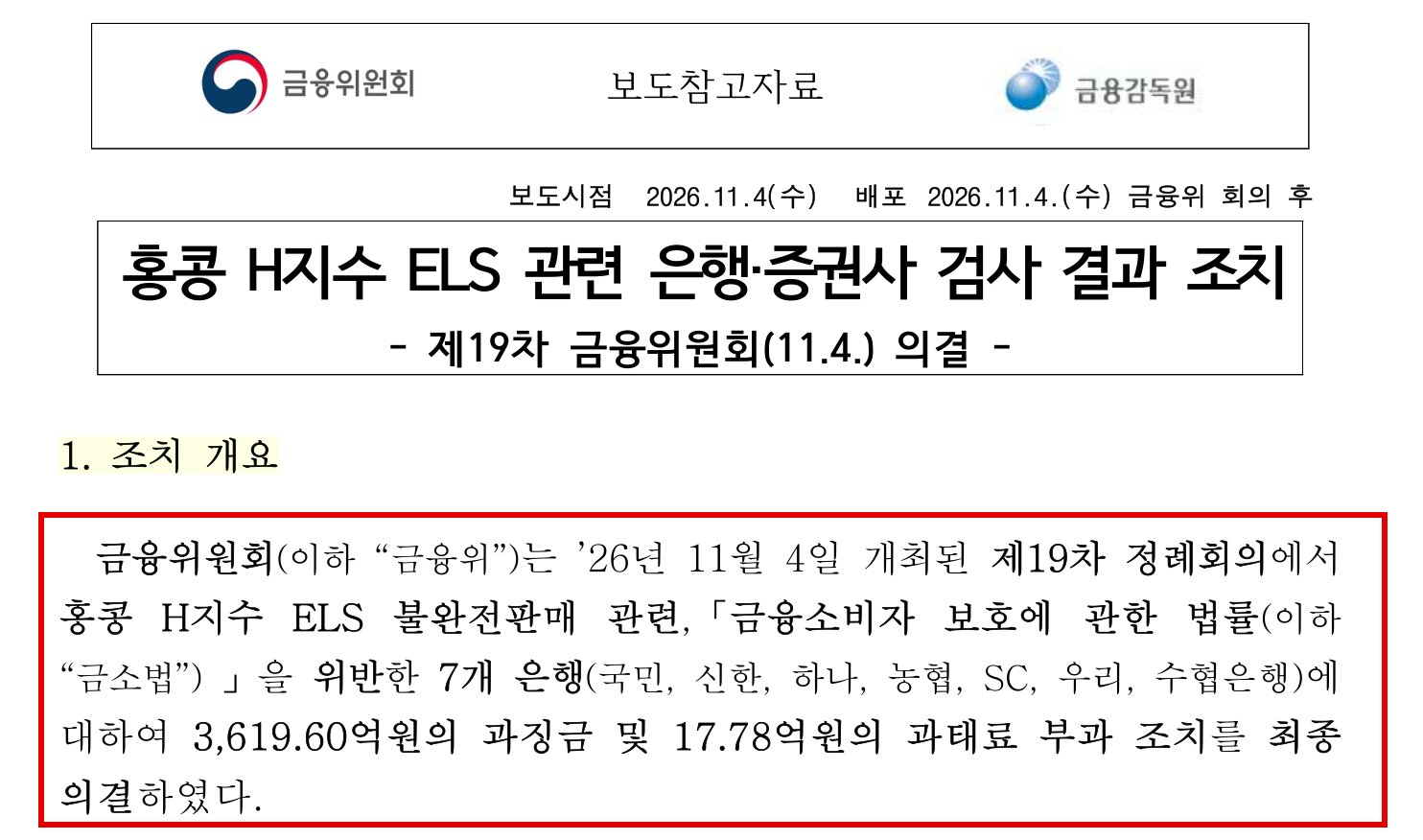
KB Kookmin Bank’s penalty is 172.334 billion won, accounting for 47.6% of the total for the seven banks. This is 1.9 times that of the second-ranked Hana Bank (92.475 billion won). Its fine is also the highest among banks at 1.3 billion won, bringing KB Kookmin Bank’s total payment to 173.634 billion won. Nonghyup Bank followed with 40.175 billion won, Shinhan Bank with 38.745 billion won, SC First Bank with 17.9 billion won, and Woori Bank with 331 million won. Suhyup Bank only received a fine of 42 million won.
The violations disclosed by the FSC primarily concern the explanation procedures at sales counters. Banks either omitted the results of yield simulations (backtesting) that calculated potential losses by applying products to past market trends, or used asset management statements that changed the analysis period to 10 years, among other things. Some banks only explained the profit and loss structure as ‘determined by changes in the underlying asset’, and determined investment suitability based on investment propensity assessments that excluded the customer’s financial situation.
The penalty was significantly reduced during the deliberation process. The Financial Supervisory Service (FSS) initially estimated the amount at 4 trillion won, then pre-notified it as around 2 trillion won in November last year, and in February this year, the Sanctions Review Committee decided on 1.4 trillion won and submitted it to the FSC. When the FSC requested supplementary facts and legal principles, it was lowered again to around 600 billion won in June, and the final amount became around 370 billion won. It is understood that the reduction reflected factors such as banks’ voluntary compensation and the exclusion of sales made during the grace period immediately after the implementation of the Financial Consumer Protection Act.
The FSC stated that this decision is the largest monetary sanction imposed by the FSC, and clarified that ‘severe responsibility, in accordance with law and principle, will follow for violations of the Financial Consumer Protection Act, such as mis-selling’.
Regarding this decision, bank workers pointed to management’s responsibility. The Korean Federation of Financial Industry Unions, in a statement issued today in the name of Chairman Yoon Seok-gu, evaluated the reduction of the penalty from around 2 trillion won at the time of pre-notification to around 300 billion won as ‘a result of struggle’, but also stated that ‘the policies that allowed the sale of high-risk products and the management’s excessive performance competition’ must be addressed.
The Financial Union stated, ‘Bank and financial holding company management must change their excessive sales targets and performance-oriented evaluations,’ and added, ‘We will rectify the practice of ignoring responsibility for determining products and sales targets, while shifting the responsibility and costs of incidents to frontline workers’.
The actual burden on KB Kookmin Bank is smaller than the amount it had prepared for. According to KB Kookmin Bank’s semi-annual report, as of the end of June this year, it had set aside 360.894 billion won as ‘other provisions related to ELS penalties, etc.’ The current penalty and fine of 173.634 billion won represent 48% of this amount. Breaking down the disclosure, the remaining approximately 187.3 billion won will return as book profit as the provisions are reduced.
■ CEO at Time of Sale and Compensation, KB Financial Chairman Appointment on the 20th
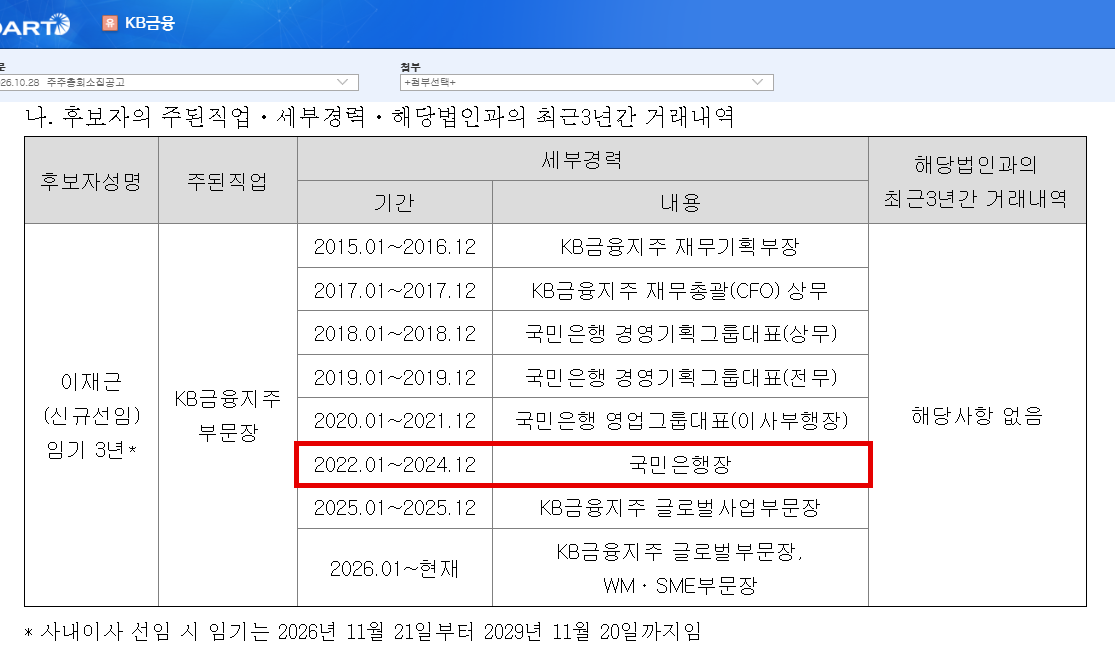
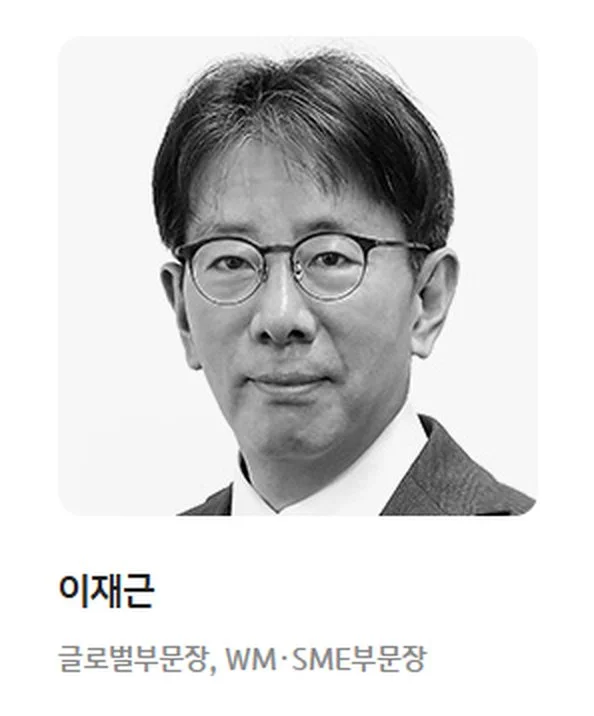
Lee Jae-geun, Head of Business at KB Financial Group, served as CEO of KB Kookmin Bank from January 2022 to December 2024. Immediately before becoming CEO, from January 2020 to December 2021, he was the Head of the Sales Group (Executive Vice President) at KB Kookmin Bank. 2024, when the Hong Kong H-index plummeted, losses were confirmed, and voluntary compensation by banks was underway, was his last year as CEO. He currently holds the positions of Head of Global Business and Head of WM & SME Business at KB Financial Group.
The KB Financial Chairman Candidate Recommendation Committee selected Lee as the sole candidate for the next chairman on September 11. According to the notice of shareholders’ meeting issued by KB Financial on the 28th of last month, the agenda for the extraordinary general meeting of shareholders to be held on the 20th at KB Kookmin Bank’s headquarters in Yeouido, Seoul, is the appointment of Lee Jae-geun as an executive director. Electronic voting will take place from the 9th to the 19th.
The penalty sanction process continued for nearly two months after Lee was selected as a candidate. Ultimately, the amount of KB Kookmin Bank’s sanction was finalized just 16 days before the shareholders’ meeting for his appointment as chairman. The penalty will be paid by the current KB Kookmin Bank, led by CEO Lee Hwan-ju.
KB Financial does not have a controlling owner. The largest shareholder is the National Pension Service, with an 8.68% stake as of the end of last year. Chairman candidates are recommended by the Chairman Candidate Recommendation Committee, composed of outside directors, and appointed by the shareholders’ meeting.
As follow-up measures, the FSC announced that it would prepare guidelines for explaining investment products and implement them in the first quarter of next year, and support the processing of an amendment to the Financial Consumer Protection Act that includes principles for financial consumer protection, ensuring financial companies operate in the best interests of consumers. Provisions for the responsibility of management who set sales targets were not included in this resolution.