
Hyundai Motor employee claims “not even A4 paper provided,” citing management crisis… Company also says “every month is emergency management,” headquarters profit margin in 4% range
English translation of the original Korean report. Images and source documents may contain Korean text.
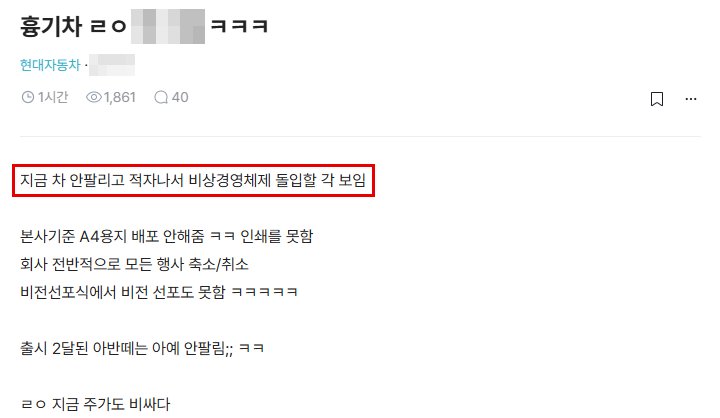
An employee identified as belonging to Hyundai Motor posted on the anonymous worker community Blind, “Looks like we’re entering emergency management because cars aren’t selling and there’s a deficit.” Hyundai Motor had already officially announced emergency management. Consolidated results were in the black through the third quarter, but Hyundai Motor’s standalone profit margin excluding subsidiaries had thinned to the 4% range.
According to Blind on the 4th, a user identified as belonging to Hyundai Motor claimed in a post using a derogatory expression about Hyundai Motor in the title that the headquarters was not providing A4 paper so they couldn’t print, and most company events were reduced or canceled. They wrote that they couldn’t announce the vision at the vision declaration ceremony, and the new Elantra, which has been out for two months, also had sluggish sales.
The post exceeded 1,400 views and received 38 comments in less than an hour after being uploaded.
Criticism of vehicle prices also continued. When a user identified as “New Company” pointed out that the Elantra price was too high, the author replied that at that price they would buy a BMW 3 Series or Tesla.
When a user identified as belonging to NK Max asked who was responsible for Elantra pricing, a user identified as belonging to Hyundai Mobis compared the department to a privileged class. The author also argued that Hyundai Motor’s product division is an organization where it is difficult to hold people accountable internally. However, the actual pricing decision process and personnel responsibility were not confirmed.
Claims also conflicted regarding production site conditions. When a user identified as a civil servant asked which was correct, claiming another Hyundai Motor employee said workloads remained the same, the author rebutted that employees were sitting idle because there were no vehicle orders. They also pointed out that the number of projects and actual sales volume are separate matters. Specific data on production line operating rates and workloads by department were not provided.
Reactions to Hyundai Motor’s management situation were also mixed. A user identified as belonging to AJ Networks pointed out that while Hyundai Motor employees enjoy job security and performance bonuses, only shareholders seem to be suffering. A user identified as belonging to SK Eco Plant criticized the Ulsan plant labor union for prioritizing employee compensation over company conditions. A user identified as belonging to LG Chem questioned whether Hyundai Motor was entering emergency management after their own company, and a user identified as belonging to Samsung Electronics reacted that the burden of emergency management could concentrate on regular employees rather than executives.
■ Hyundai Motor acknowledges emergency management… Despite third-quarter profit, sharp sales decline and lowered performance targets
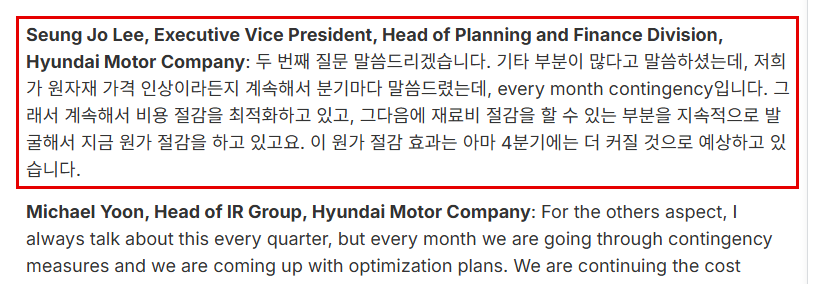
The term emergency management came from the company first. Hyundai Motor announced at the third-quarter earnings conference call (earnings explanation telephone conference) last month on the 29th that “every month is emergency management (contingency) mode.” Lee Seung-jo, Hyundai Motor Finance Division Head (Vice President), explained, “We are operating monthly contingency plans to respond to raw material price increases and optimizing cost reduction.”
The released results are in the black. Hyundai Motor’s third-quarter operating profit was 2.6772 trillion won, up 5.5% from a year ago. Revenue was 45.1102 trillion won, down 3.4%, but operating profit margin was 5.9%, and net income was also 1.9317 trillion won in the black.
The possibility of a fourth-quarter deficit also deviates from the company’s outlook. If Hyundai Motor’s annual targets presented at the earnings announcement (revenue growth of 1-2%, operating profit margin of 5.5-6.5%) are applied to last year’s revenue of 186.2545 trillion won and calculated backward, even at the lowest estimate, operating profit of about 2.3 trillion won must be generated in the fourth quarter to reach the target. Cumulative operating profit through the third quarter is 8.0428 trillion won.
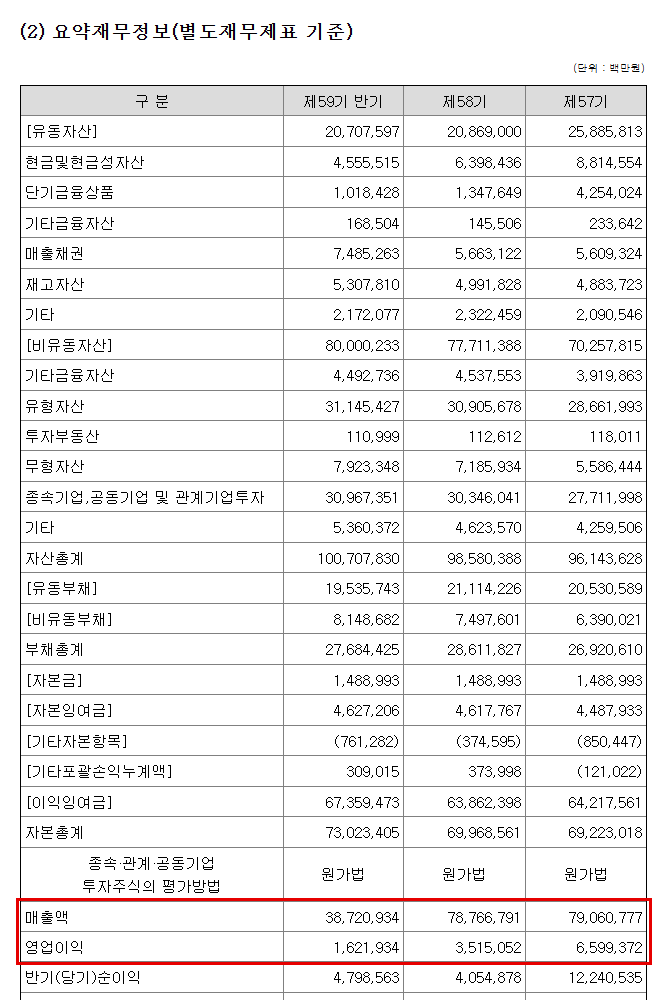
However, Hyundai Motor’s standalone results excluding subsidiaries are much thinner. First-half standalone operating profit was 1.6219 trillion won, with an operating profit margin of only 4.2%. Last year’s annual standalone operating profit (3.5151 trillion won) also fell to 53% of the previous year (6.5994 trillion won). Standalone results for the third quarter, when domestic sales fell by more than 27%, will be released in the quarterly report in mid-month.
Sales definitely decreased. Third-quarter wholesale sales were 920,710 units, down 11.3%, and domestic sales were 131,468 units, down sharply 27.2%. Hyundai Motor cited fewer business days and domestic factory production disruptions as reasons.
The company also lowered its annual targets. The annual wholesale sales target was lowered from 4.1583 million units to 4 million units, and the operating profit margin target was lowered from 6.3-7.3% to 5.5-6.5%. The automotive sector investment plan was also reduced by 1.8 trillion won, from 17.8 trillion won to 16 trillion won. The company explained that the impact of U.S. tariffs will continue, so management environment uncertainty will persist for the time being.
■ New Elantra, not ‘not selling at all,’ but down 1,444 units in a month
The claim that “the Elantra isn’t selling at all” is an exaggeration. According to industry tallies, the new Elantra sold 5,501 units in October: 5,050 gasoline and 451 hybrid. However, that is 1,444 fewer than September (6,945 units), when there was no hybrid model. Despite the addition of the hybrid option, it failed to make up for the decline in gasoline sales.
Total Elantra sales including old-model inventory were 5,730 units, down 4.7% from a year ago and 21.6% from a month ago. Hyundai Motor as a whole also saw October domestic sales of 49,042 units, down 8.9%, and global sales including overseas of 329,773 units, down 6.3%.
Hyundai Motor’s largest shareholder is Hyundai Mobis, which held 22.36% as of the end of last June. Combined with related parties, the stake is 30.67%. Hyundai Motor Group Chairman Chung Eui-sun, who is also Hyundai Motor CEO, holds 2.73%, and Hyundai Motor Group Honorary Chairman Chung Mong-koo holds 5.57%. Hyundai Mobis’ largest shareholder is Kia (18.10%), and Chairman Chung’s Hyundai Mobis stake is 0.33%.
Hyundai Motor is pinning hopes on cost reduction. The division head said on the conference call, “We are continuously identifying areas where material costs can be reduced, so we expect the cost reduction effect to be even greater in the fourth quarter.” The new Tucson, which sold 1,428 units in October, will be delivered to customers in full scale starting this month.