
Jeong Ki-sun Emphasizes ‘Human Security’… HD Hyundai ‘Unresponsive to International Human Rights Group’s Inquiry’ Regarding Allegations of Palestinian Home Demolitions
English translation of the original Korean report. Images and source documents may contain Korean text.
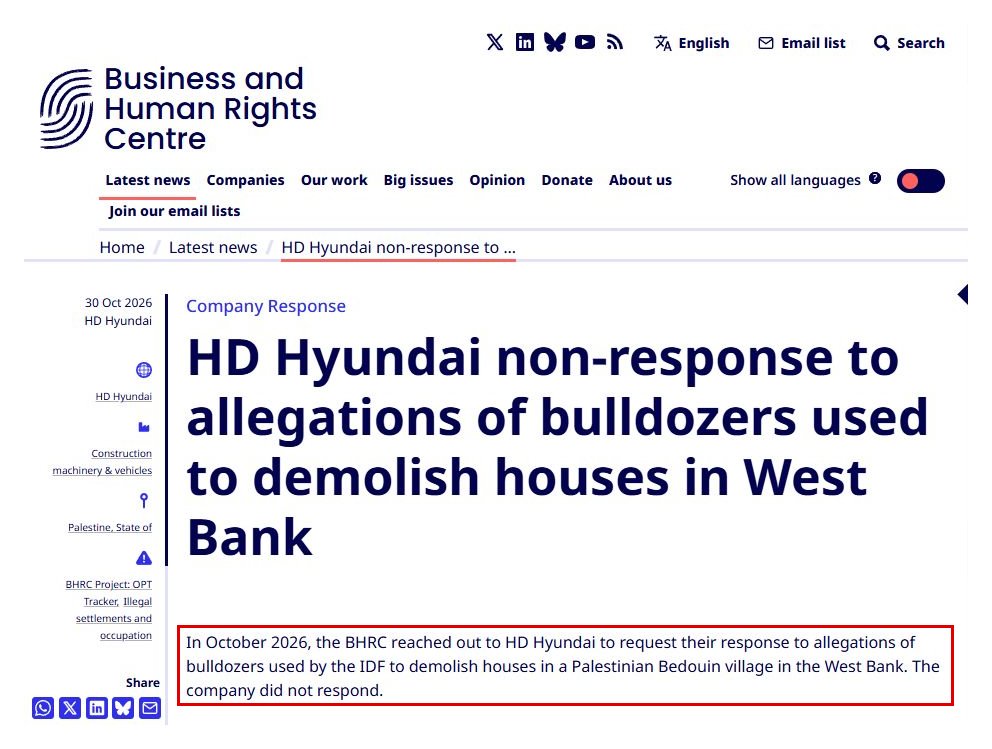
Jeong Ki-sun, Chairman of HD Hyundai, presented the productivity and sustainability of the construction industry as key to solving human security issues, but the company did not respond to an inquiry from a human rights organization regarding the alleged use of its equipment in the demolition of Palestinian homes.
Investigation results showing that Hyundai excavators were also used in the construction of roads and settlement outposts by Israeli settlers have emerged, raising questions about the effectiveness of human rights due diligence for equipment sold overseas.
According to public records from the Business & Human Rights Resource Centre (BHRC) on the 2nd, the center recently inquired with HD Hyundai about allegations that its equipment was used in the demolition of Palestinian homes but did not receive a reply. The center disclosed this information on October 30. U.S. construction equipment manufacturer Caterpillar also did not respond to the same inquiry.
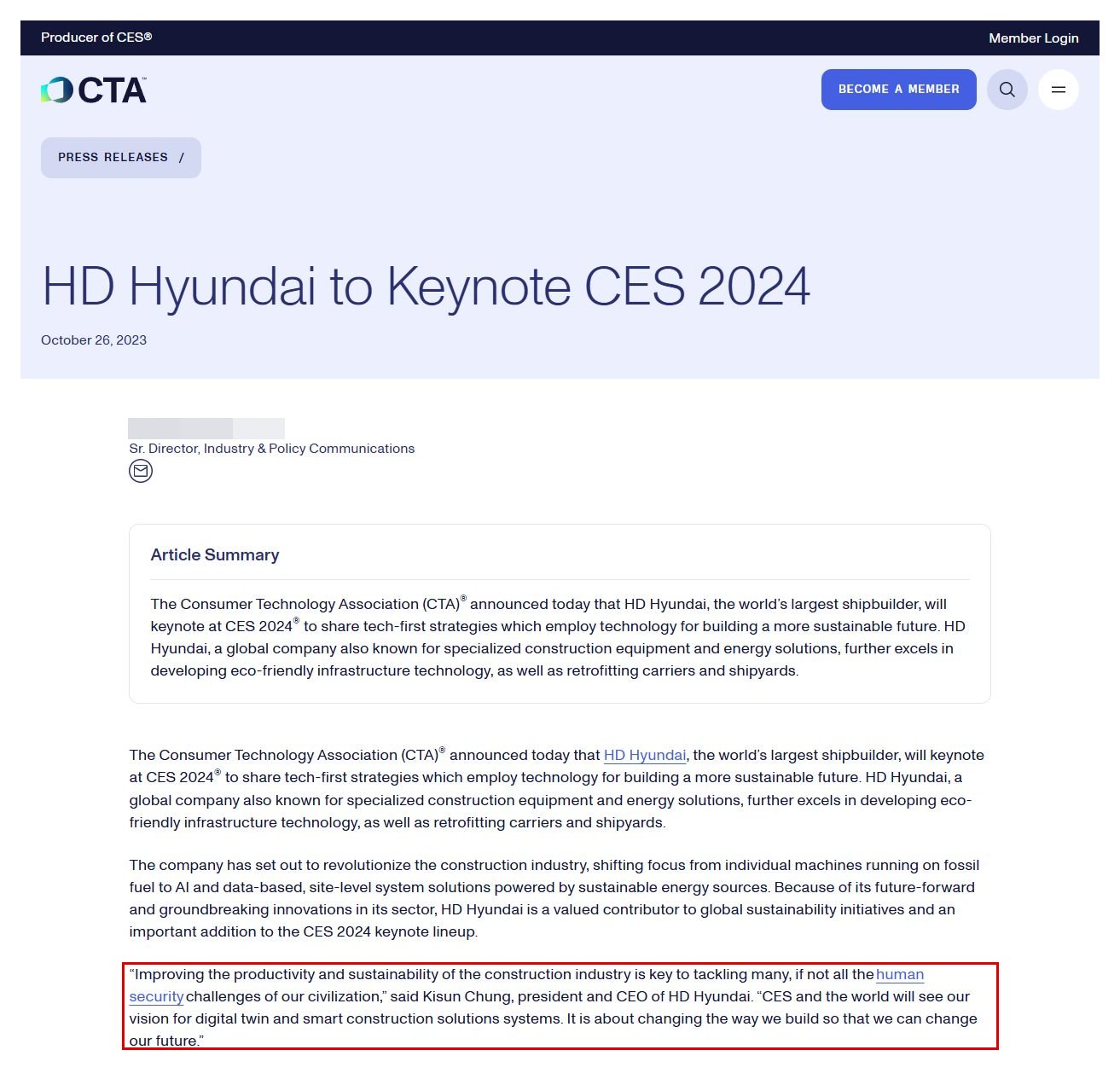
Chairman Jeong emphasized in a statement released by the Consumer Technology Association (CTA), the organizer of CES, on October 26, 2023, that increasing the productivity and sustainability of the construction industry is key to solving the human security issues humanity faces. This was stated by Chairman Jeong, then CEO of HD Hyundai, while explaining the vision for innovation in the construction industry, including digital twins and smart construction solutions.
The basis for this inquiry is the demolition incident reported in May last year. The BHRC determined that Hyundai and Caterpillar equipment appeared in AP’s news video at the time. AP reported that on May 5 last year, nine homes, five tents, and five livestock pens were demolished in the village of Hallet al-Dab in the southern West Bank.
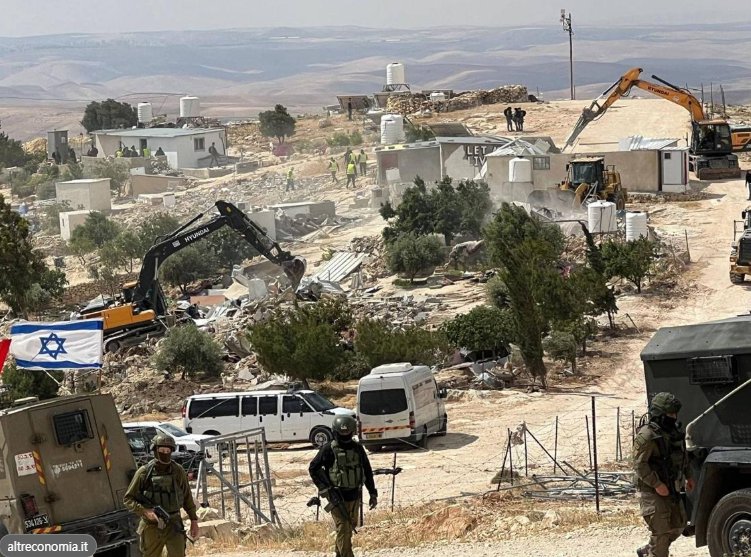
The Israeli military administration stated at the time that it had demolished structures built illegally in a closed military training zone. Residents complained that obtaining building permits from Israeli authorities in the West Bank is virtually impossible.
The issue of equipment use had been raised previously. In an investigation verifying 347 photos and videos in March last year, Amnesty International identified 59 Palestinian-owned structures, including homes and shops, demolished by Hyundai equipment between September 2019 and February last year, and announced that approximately 250 people were forcibly displaced.
A separate case of Hyundai excavator use appears in Amnesty International’s investigative report on Bedouin and pastoral communities in the West Bank, released on June 10 this year. The report documented that on July 28 last year, settlers carried out earthwork near Umm al-Khair village using a Hyundai excavator to install a new road and mobile structures.
Amnesty explained that the excavator, after completing its work, attempted to pass through a resident-owned olive grove and clashed with residents. Residents blocked its path, and at least one person threw a stone at the equipment’s windshield, and the excavator’s hammer struck one resident’s head, knocking them down.
Amnesty subsequently reported that at the same site, settler Yinon Levi fired a pistol, killing Aouda Al-Hathaleen, a Palestinian human rights activist and teacher. According to updated records from the Israeli human rights organization B’Tselem and AP reports, Levi was indicted in August this year for this incident, and Levi’s side claimed self-defense and denied the charges.
Amnesty also tracked changes at the site after the construction. It stated that satellite images from January 30 this year confirmed structures appearing to be mobile buildings and a newly paved connecting road.
HD Hyundai denied involvement in past allegations of equipment use. According to the response released by Amnesty, HD Hyundai Site Solutions stated on March 25 last year that it was not involved in activities in the disputed region. Earlier in 2024, it issued a statement saying that a review of local dealer records showed no sales records to government agencies for demolition work in Israel or similar activities.
■ Promise to Expand Human Rights Due Diligence… Publicly Disclosed Assessment Targets Domestic Workplaces
HD Hyundai’s construction equipment business was integrated this year into HD Construction Equipment, combining HD Hyundai Construction Equipment and HD Hyundai Infracore. The current CEO is Moon Jae-young. As of the end of June disclosure, the largest shareholder is HD Hyundai Site Solutions with a 35.89% stake, and HD Hyundai fully owns the shares of this company.
The largest shareholder of the holding company HD Hyundai is Chung Mong-joon, Chairman of the Asan Foundation. As of the October 2 disclosure, Chairman Chung’s stake is 23.05%, and his son Jeong Ki-sun, Chairman of HD Hyundai, holds a 9.67% stake. Chairman Jeong also serves as the CEO of HD Hyundai Site Solutions.
HD Construction Equipment explained its human rights management oversight system in its 2025 Sustainability Report, published this year. It is structured such that the ESG Committee, under the board of directors and chaired by Director Yoo Myung-hee, deliberates on major policies, and the Human Rights Management Committee is responsible for selecting improvement tasks and monitoring their implementation. According to this report, the ESG Committee approved the human rights management policy and implementation plan in July last year.
HD Construction Equipment stated in its human rights management declaration on its website, under the name of CEO Moon Jae-young, that it will regularly monitor human rights risks in its business operating regions, rectify negative impacts, and disclose the results.
The publicly disclosed human rights impact assessment from last year targeted domestic workplaces. The company explained that it was evaluated using 367 indicators, received 888 points out of a possible 1000, and identified 72 improvement tasks. Key tasks included establishing consultation guidelines and policies for protecting the human rights of local residents, and developing procedures to assess human rights protection during contract renewals.
Overseas due diligence was presented as an expansion plan. The company stated that it plans to complete human rights due diligence for all its global workplaces by 2030 and conduct on-site assessments every two years for domestic workplaces and every three years for overseas workplaces. The approach is to evaluate major overseas production subsidiaries first, then expand to sales subsidiaries.