
Hyundai Card Vice Chairman Chung Tae-young Said Unisex Restrooms Would ‘Greatly Reduce Waiting Times’…Employee Says ‘There Aren’t Enough Stalls and the Toilets Won’t Flush’
English translation of the original Korean report. Images and source documents may contain Korean text.
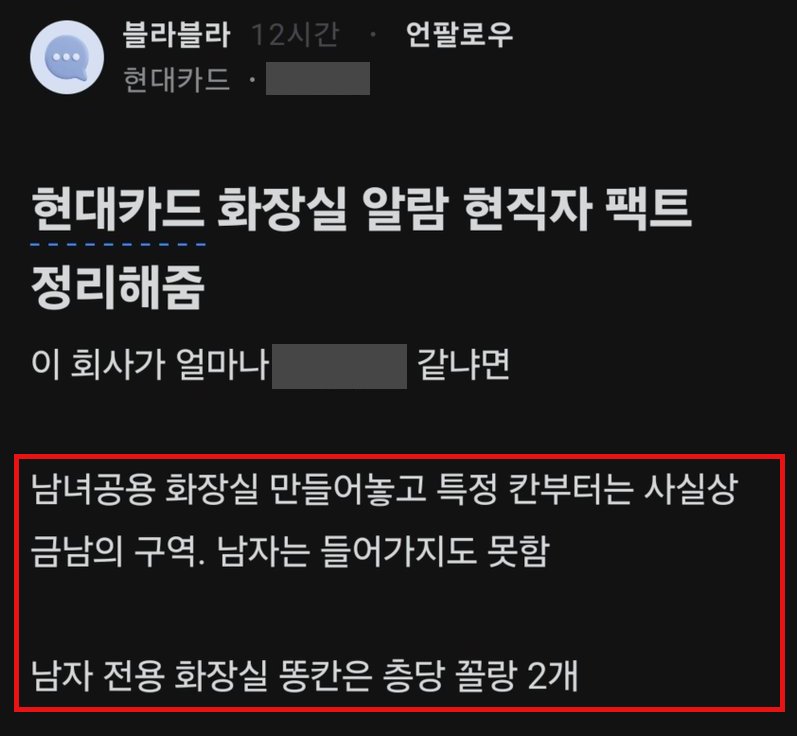
Employee Claims Only Two Men’s Sit-Down Toilets per Floor…Company Tests ‘Alarm for Staying Too Long’ Instead of Adding Stalls
A Hyundai Card employee has argued that the company’s trial of a restroom occupancy-time alarm addresses the wrong problem, saying the issue lies not with employees but with the restroom layout. According to the employee, after the restrooms were converted to unisex facilities, only two sit-down toilets per floor remained available to men, and poor flushing further prolonged restroom visits. The unisex restroom conversion was a project personally announced and promoted by Chung Tae-young, Vice Chairman and CEO of Hyundai Card, who said it would ‘greatly reduce waiting times.’
According to Blind, an anonymous workplace community, on the 11th, an author identified as a Hyundai Card employee wrote in a post titled ‘Current Employee Sets the Record Straight on Hyundai Card Restroom Alarms’ that the company had ‘created unisex restrooms, but from a certain stall onward, they are effectively off-limits to men.’ The author said the men’s restrooms have only two sit-down toilets per floor. The post also appeared on the popular posts board of the automotive community Bobaedream that day and spread further.
The author said the water pressure was so weak that the toilets would barely flush even after repeatedly adding toilet paper and flushing several times. The author wrote, ‘There aren’t enough stalls and the toilets won’t flush. It would be a miracle if it didn’t take time.’ Another commenter identified as a Hyundai Card employee said each floor has one men’s restroom, one women’s restroom and one unisex restroom, with about five toilets available to women, including those in the unisex restroom.
The author claimed that instead of fixing the facilities, the company issued a company-wide notice banning ‘hwakangs,’ or taking breaks in the restroom, and gaming, and was now planning to install alarms, saying the company was ‘blaming employees for it.’ Hyundai Card reportedly tested sensor-equipped bells in parts of its Yeouido headquarters that sound an alarm when restroom use exceeds a set time limit. A Hyundai Card official told Yonhap News TV, ‘It may have been an idea prompted by the thought that if someone stays in the restroom too long, the line gets longer.’ In effect, the company itself acknowledged that restroom lines were long.
■ Unisex Restroom Conversion Promised to ‘Greatly Reduce Waiting Times’…Nine Years Later, an Alarm to Address Long Lines
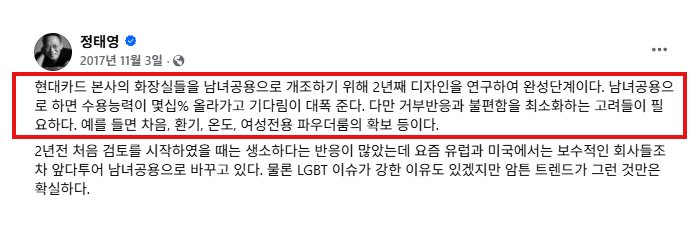
On November 3, 2017, Vice Chairman Chung wrote on Facebook, ‘We have been studying designs for two years to convert the headquarters restrooms into unisex facilities, and the project is nearing completion.’ His stated rationale was that ‘making them unisex would increase utilization capacity by several tens of percent and greatly reduce waiting times.’ A wave of safety concerns followed, including fears of illegal filming. In 2019, the company explained that the restrooms then undergoing remodeling ‘simply share a single corridor leading to the men’s and women’s restrooms; inside, they remain divided into men’s and women’s restrooms, just as before.’
Nine years later, employees say the shared restroom layout has left too few stalls available to men, creating lines. Instead of delivering the ‘reduced waiting times’ promised by the company’s chief executive, the company’s proposed measure was an occupancy-time alarm rather than additional stalls. The company explained, ‘While testing emergency call devices intended to respond to situations such as medical emergencies, we also tested various functions included in the devices, and no decision has been made on whether to introduce them.’
■ Chung Tae-young and Chung Myung-yi Receive 4.749 Billion Won in First-Half Compensation…Hyundai Card Wage Talks Remain Deadlocked
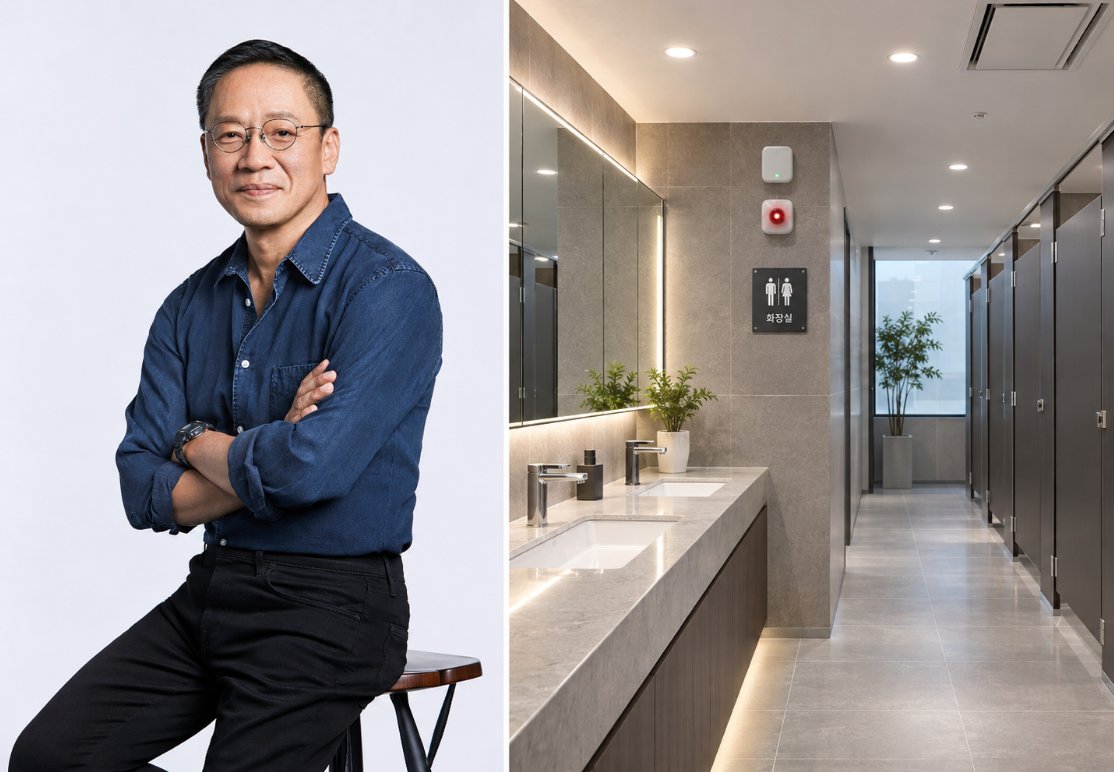
Vice Chairman Chung is the husband of Chung Myung-yi, President of Hyundai Commercial and the second daughter of Chung Mong-koo, Honorary Chairman of Hyundai Motor Group. He is also the brother-in-law of Chung Euisun, Executive Chair of Hyundai Motor Group, through his marriage to Chung Myung-yi, who is Chung Euisun’s older sister. Vice Chairman Chung has led Hyundai Card since 2003 and concurrently serves as CEO of Hyundai Commercial, while President Chung Myung-yi also serves as an inside director of Hyundai Commercial.
The couple receive compensation from the two companies. According to the Financial Supervisory Service’s electronic disclosure system, Vice Chairman Chung received 1.618 billion won from Hyundai Card and 1.633 billion won from Hyundai Commercial in the first half of this year, totaling 3.251 billion won. Adding the 1.498 billion won that President Chung Myung-yi received from Hyundai Commercial brings the couple’s combined compensation for the six-month period to 4.749 billion won. Hyundai Card reported consolidated net profit of 350.3 billion won last year and earned another 185.2 billion won in the first half of this year.
Hyundai Card’s largest shareholder is Hyundai Motor Company, with a 36.96% stake, followed by Hyundai Commercial, with 34.60%. In Hyundai Commercial, President Chung Myung-yi holds 27.91% and Vice Chairman Chung Tae-young holds 13.91%, giving the couple a combined stake of 41.82%. That exceeds the 41.48% stake held by Hyundai Motor Company, Hyundai Commercial’s largest individual shareholder. In the second quarter of this year, when Hyundai Commercial repurchased and canceled its own shares, the couple each purchased 20,000 shares. After Vice Chairman Chung stepped down as CEO of Hyundai Capital in September 2021 to focus on Hyundai Card and Hyundai Commercial, reports raised the possibility that the two companies could be separated from Hyundai Motor Group. Hyundai Motor Group said it was not considering such a separation.
Meanwhile, Hyundai Card’s wage negotiations, which began in February this year, remained unresolved through the 23rd round of bargaining on October 19. The union reportedly demanded a 5.9% pay increase, while the company offered between 2% and 2.5%. The company said it had not yet decided whether to introduce the restroom alarms.