
Pyeongtaek ‘Hanwha Forena Jije Station’ 84㎡ up to 724.5 million won… ‘Factory Proximity, Registration Delay’ Warning in Subscription Notice
English translation of the original Korean report. Images and source documents may contain Korean text.
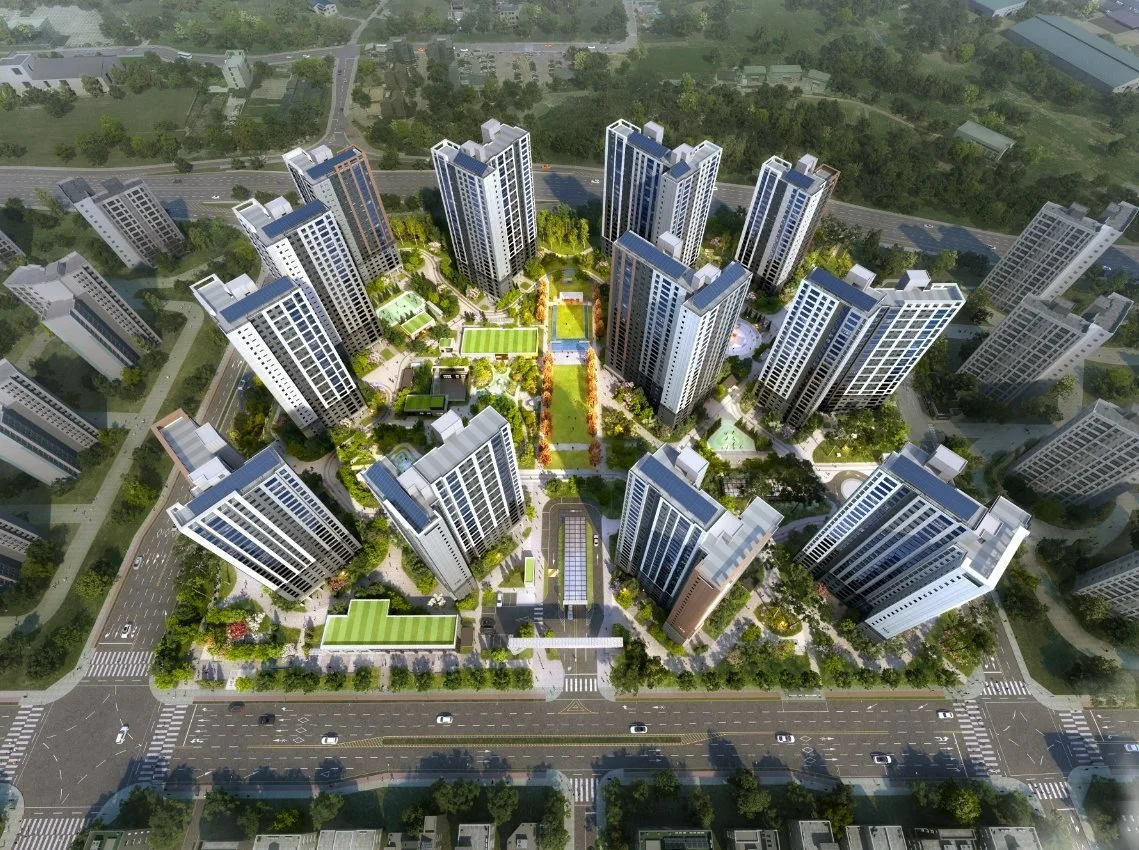
The sale price for exclusive use 84㎡ units at ‘Hanwha Forena Jije Station’ in Pyeongtaek, Gyeonggi Province, which Hanwha Construction Division (CEO Kim Seung-mo) will begin receiving subscriptions for from the 9th, has been set at a maximum of 724.5 million won. If the balcony expansion cost is added, the price of the new apartment, which will be occupied in three years, exceeds the current average transaction price of 84㎡ units in the Jije Station area.
According to the resident recruitment notice posted on the Korea Real Estate Board’s Cheongyak Home on the 4th, this complex will be built in the area of 725 Segyo-dong, Pyeongtaek-si, with 2 basement floors to 27 above-ground floors, 12 buildings, and 1,098 units. 950 units, which is 86.5% of the total, are exclusive use 84㎡.
The sale price for 84㎡ units ranges from 626.95 million won to 724.5 million won depending on the floor and type. 116㎡ units are up to 968.45 million won. Divided by the supply area, based on the highest price, it is in the range of 21.4 million to 21.6 million won per 3.3㎡.
The balcony expansion cost is excluded from the sale price. The expansion cost is 26.4 million to 27.5 million won for 84㎡ units, and 30.25 million won for 116㎡ units. If expansion is added to the highest floor of an 84㎡C unit, the total becomes 752 million won. According to KB Real Estate data, the average transaction price for 84㎡ units in the Pyeongtaek Jije Station area is 747 million won.
Even when compared to the market prices of existing complexes right next door, the difference is not significant. An 84㎡ unit at Pyeongtaek Jije Station Xi, which is in its fourth year of occupancy, was sold for 770 million won on the 13th of last month. An 84㎡ unit at Hillstate Jije Station, which is in its sixth year, was traded for 617 million won last August. This sale price falls between the market prices of the two complexes that are already occupied.
This complex is not subject to the housing price cap system. Pyeongtaek is not a regulated area, and the site is private land, not public housing land. The subscription notice stated that the sale price was determined ‘according to the liberalization of sale prices.’ The resale restriction on subscription rights is 6 months, and there is no obligation to reside or restriction on re-subscription. Even people who own homes can subscribe as a first-priority applicant.
There are many unsold homes in the Pyeongtaek housing market. According to the Ministry of Land, Infrastructure and Transport’s Statistical Nuri, unsold homes in Pyeongtaek-si totaled 3,358 units last September, an increase of 746 units from 2,612 units in February. Unsold units after completion, which were not sold even after being fully built, number 79 units.
A large volume of move-in units is also concentrated. In early next year, 5,711 units will be occupied in only four complexes in Gaje District and Brain City. According to the local real estate brokerage industry, some subscription rights in Brain City have a negative premium, which is 70 million to 80 million won cheaper than the sale price.
‘Factory Proximity’ and ‘Registration Delay’ Noted in the Subscription Notice

Content not found in company advertisements is in the precautions section of the subscription notice. The notice stated, ‘Factories and industrial complexes are adjacent to the north and south sides of this complex, and thus noise, dust, and unpleasant odors may occur.’
A 13m high sound barrier is planned on the north side of the complex, towards National Road No. 45. The notice stated that the view and sunlight of units in Buildings 107-110, next to the sound barrier, may be affected.
Registration issues also remain. The complex is located within the Pyeongtaek Yeongsin District Urban Development Project, which is being developed by landowners forming a cooperative. The notice stated that the Yeongsin District cooperative must bear the cost of ‘opening an underpass in front of Jije Station on National Road No. 1,’ and if they do not, the completion of construction and land readjustment disposition will be delayed, which ‘may lead to problems such as inability to transfer registration.’ Land readjustment disposition is a procedure to redistribute developed land back to its owners.
This cooperative has previously disputed with Pyeongtaek-si over the cost of the underpass. In November 2016, the Pyeongtaek City Council held a special investigative committee regarding the Yeongsin District development. At that time, the special committee addressed the issue of the cooperative refusing project costs, such as the construction of the National Road No. 1 underpass. The cooperative’s position was that the underpass plan had lost its validity and that traffic-related charges had already been paid.
The liability structure of the sale contract is also a point to consider. This project uses a managed land trust method. Although Korea Investment Real Estate Trust is the seller on the contract, the notice stated that the trust company is only responsible within the scope of the trust assets, and the developer, IJD&C, bears the seller’s obligations and responsibilities. IJD&C is a company that does not submit audit reports to the Financial Supervisory Service’s electronic disclosure system, so its financial status cannot be viewed through public data. Hanwha Co., Ltd. is in charge of construction.
The company highlighted that Samsung Electronics Pyeongtaek Campus is approximately 5 km away and Pyeongtaek Jije Station (SRT and Subway Line 1) is within walking distance. The contract terms are a 10% down payment and a 60% intermediate payment with deferred interest. Deferred interest is a method where the interest on intermediate payment loans is paid all at once upon move-in. The notice stated that the contractor can move in only after paying the full sale price, expansion costs, and deferred interest.
Meanwhile, Hanwha Energy, with a 23.56% stake, is the largest shareholder of Hanwha Co., Ltd. Kim Seung-yeon, Chairman of Hanwha Group, holds 12.04%, and Kim Dong-kwan, Vice Chairman and CEO of Hanwha Co., Ltd., holds 10.39% (as of the end of June). Kim Dong-kwan, Vice Chairman, holds 50% of Hanwha Energy’s shares, Kim Dong-won, President of Hanwha Life, holds approximately 20%, and Kim Dong-seon, Vice President of Hanwha Hotels & Resorts, holds 10%.